
World
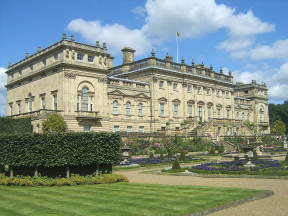
What really paid for the ballgowns, portraits and country estates of Georgian Britain? Historian Miranda Kaufmann peels back the polished veneer of Britain’s heiresses to reveal fortunes forged in Caribbean slavery. Beneath the elegance of marriage markets and inheritance battles lies a darker story of exploitation, empire and human resilience....
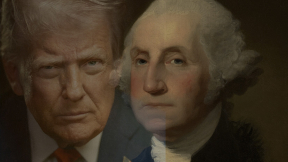
For the last two and a half centuries, the USA has been shaped by a remarkable sense of its own unique place in world history, yet consumed by never-ending battles over what this means. 250 years after the Declaration of Independence was signed, the United States appears to be at...
The HA and the Economic History Society are developing a new partnership. Affiliates of the EHS contributed to our Teacher Fellowship programme: Teaching the economic history of colonialism in Africa and Asia. As part of the development of closer links, we are delighted to support the dissemination of The History...
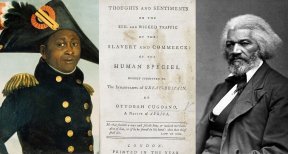
This talk explored the struggle for liberation from the perspective of the enslaved, wherever possible in their own words. Dr Sudhir Hazareesingh shines a light on the lives of revolutionaries like Toussaint Louverture, José Antonio Aponte, Nat Turner, and the pregnant rebel Solitude; touching on the stories of the freed...
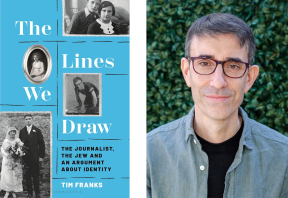
In this Virtual Branch Tim Franks, acclaimed BBC Journalist, talks about his personal history and identity drawing on his new biography The Lines we Draw: The Journalist, The Jew and an argument about identity. We will delve into Tim's experiences as a journalist in some of the world's major conflict...
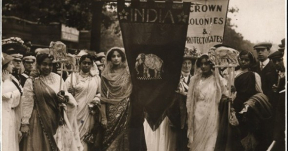
Between 1917 and 1947, women in the Indian subcontinent were engaged in active debates and noteworthy demonstrations for the vote, building up a national suffrage movement. In this talk Professor Sumita Mukherjee discusses the activities of Indian suffragettes in this period, showing how they were connected with British and other...
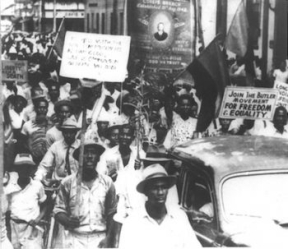
This webinar examines the era of ‘post-emancipation’ in the Caribbean from around the mid-nineteenth to the mid-twentieth centuries. It interrogates the notion of ‘emancipation’ and asks what kind of ‘freedom’ did abolition bring to the formerly enslaved? How did colonial states and other authorities seek to regulate the lives of...
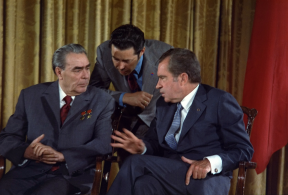
(Student and corporate secondary members can view these films in our Student Zone) Leonid Brezhnev was the second longest serving leader of the Soviet Union after Stalin, overseeing some of the most difficult relations between East and West, yet he does not have the popular cultural legacy of some of...
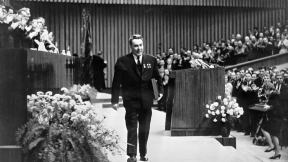
In this film Dr Edwin Bacon takes us through Brezhnev’s early life and career: his birth in Ukraine in 1906, the opportunities brought by the revolution, his role in the battle of Ukraine and his eventual arrival to the Politburo at the end of the 1950s. Dr Bacon looks at...
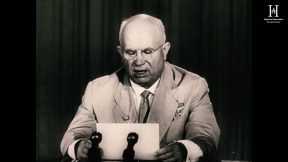
In this film Dr Edwin Bacon reflects upon the instability of the Khrushchev era and how Brezhnev positioned himself as the perfect replacement for a Soviet Communist party desperate for stability in the wake of the Cuban missile crisis. Brezhnev would be the first amongst equals looking to move forward...
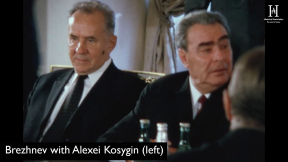
In this film Dr Edwin Bacon talks about Brezhnev’s change in direction and approach after Khruschev, making collective leadership work and the Kosygin reforms. Whilst there were changes from the era of Khruschev, Brezhnev’s response to the Prague Spring in 1968 showed that some things had not changed. The events...
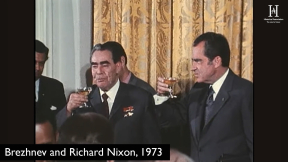
In this film Dr Edwin Bacon blanks about the modernisation of the soviet union in the 1960s and 70s under Brezhnev, with some scholars predicting that as the East and West evolved, they would eventually converge as modern developed industrialised societies. The problem with convergence theory is that it didn’t...
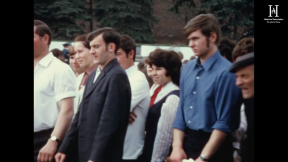
In this film Dr Edwin Bacon looks back at Brezhnev’s 18 years and how is has been described as an era of stagnation, producing an appetite for change from younger leaders such as Mikail Gorbachev. Dr Bacon reflects that this was a period of relative peace, stability and predictability which...
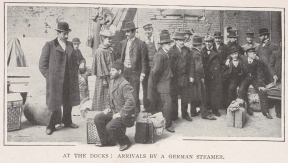
Research on the history of migration continues to flourish and grow, but scholarship is also becoming increasingly splintered, often focusing on particular settings or population groups. Migration is often used as a way to discuss questions of national identity or diverse religious, ethnic, religious and local identities in the UK,...
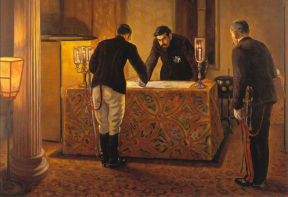
The Meiji Restoration was a political event that restored imperial rule to Japan in 1868 under Emperor Meiji. Although there were ruling emperors before the Meiji Restoration, the events restored practical power to, and consolidated the political system under, the Emperor of Japan. The Restoration led to enormous changes in...
Any study of the intercultural relationships between the Indigenous peoples of North America and British settlers usually focuses on the differences that resulted in disputes and violence. However, on closer examination, the interaction also involved the exchange of ideas and the forging of alliances, which required diplomacy and respect for...
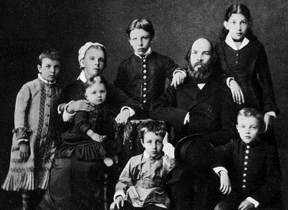
Lenin was born Vladimir Ilyich Ulyanov in 1870. This film takes us through his middle-class origins, how he was radicalised by the world he saw around him, especially following the execution of his brother, and how the future politician and revolutionary developed amongst the extremes of Imperial Russian society. In...
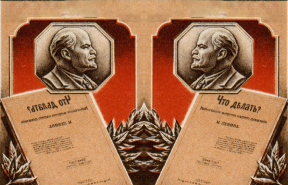
As Lenin’s own political outlook and beliefs developed so did the European movements of Socialism and Communism. Groups emerged that wanted to radically change society and social structures. Lenin positioned himself as one of the leaders and crucially one of the thinkers behind these new ideas and movements. Dr Lara...
The founders of Communism, Marx and Engels, had created a set of social structures and industrial developments that were believed necessary for Communism to be achieved. Imperial Russia did not fit these conditions and yet at the start of the twentieth century Russian revolutionaries were some of the most active...
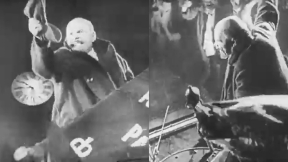
You wait a lifetime for a revolution and then two come along at once! Such was 1917 in Russia. As the world seemed in chaos and Russia and the Russian people began to collapse, Lenin and the Bolsheviks saw their opportunity and overthrew the government to create the first communist...