
Free for members
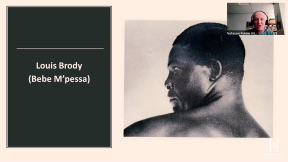
In this webinar, Professor Robbie Aitken looks at the experiences of Black residents in Germany during the Nazi period. Why have they been largely written out of larger histories of the Third Reich? Professor Aitken suggests that there was a genocidal intent in Nazi policy towards them, signalled partly by...
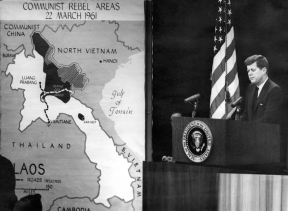
Would US President John F. Kennedy have avoided the catastrophe that became the Vietnam War if Lee Harvey Oswald had not assassinated him in Dallas on that fateful day of 22 November 1963? This question – or a version of it – has animated discussions of the Vietnam War for...
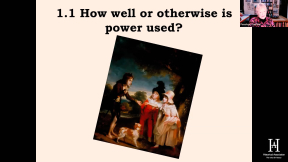
Eighteenth-century Britons were ruled by a restricted oligarchy of landowners and plutocrats. Yet the wider population had a proud tradition of assertiveness and readiness to protest. ‘Britons never will be slaves!’ as the chorus of 'Rule Britannia' (1740) announced pointedly (if somewhat ironically, in view of Britain’s role in the...
Decline, decadence, crisis, stagnation, and adversity are terms powerfully associated with the reign of Spain’s Planet King; sombre tones that contrast sharply with the glittering cultural and artistic achievements (enhanced by his patronage) that led the period to be dubbed ‘the’ Golden Age, a label consciously competing with France’s later...
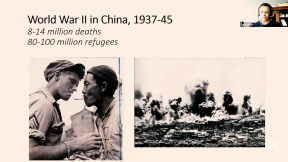
The Chinese regime never used to want to talk about their country’s experience in World War Two. The Japanese occupation of parts of China was felt to be a humiliating episode that was best forgotten, and the Communists were uncomfortable that their nationalist enemy Chiang Kai-Shek had been China’s main...
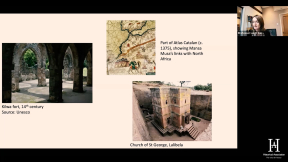
Popular discussions of Africa often focus on the region’s relative poverty, and ask what role historical events like colonialism and the slave trade have played in shaping its development over time. For a long time, the absence of systematic data on African economies before c. 1960 meant these discussions were...
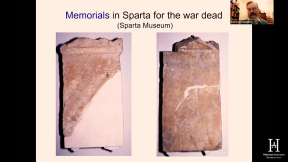
This webinar starts with a basic overview of the city-states of Classical Greece (roughly 500 to 350 BC) and Sparta’s place within their geography and history. It then looks at some common myths about the nature of Spartan society and politics, focusing on areas where recent research has transformed our...
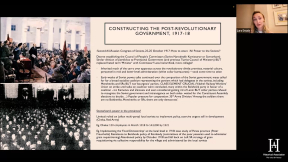
In this webinar Dr Douds examines the nature of political authority in the nascent Soviet Republic and the institutional structures, practices and ideology of government in the Lenin period. She considers how Communist Party dictatorship and the monolithic party-state emerged in the early years following the October Revolution of 1917...
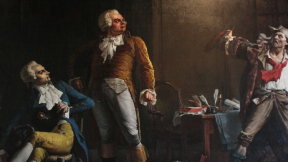
One of the oldest myths of the French Revolution is the lethal rivalry between Robespierre and Danton: Robespierre the cold, bloodthirsty dictator who ruled France through Terror, versus Danton, the warm, humane, inspirational orator who wanted to stop Terror. Throughout the 19th century Robespierre was mostly depicted as a villain,...
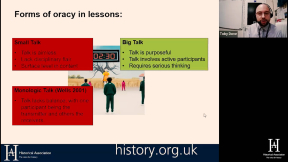
Webinar series: Effective oracy in the secondary history classroom What does great oracy look like in history? This webinar explores the features of good student oracy in a non-disciplinary sense, but also within the setting of a history classroom. It explores how to identify these features in the day to...
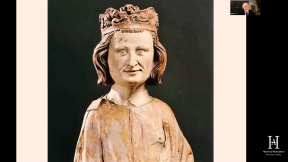
David Carpenter brings to life the dramatic events in the last phase of Henry III’s momentous reign, provides a fresh account of the king’s strenuous efforts to recover power and sheds new light on the rebel figure Simon de Montfort. Professor David Carpenter is a Professor of Medieval History at...
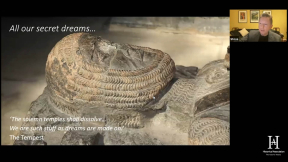
The word Templars conjures up a variety of images and ideas – much of which are fiction rather than fact. In this talk Dr Steve Tibble will unpick some of the stories surrounding this group and place them in a proper historical and factual context. He will explore why the...
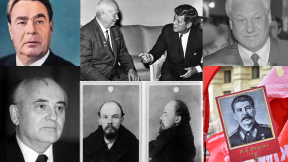
How much of what Russia is today, how its people behave, and how they are perceived is dependent on its history and those that have led it? Was it the first melting pot of the world? Do its broad range of cultural traditions and diversity play a part in its...
Since 2001 the UK has marked Holocaust Memorial Day on 27th January, the date of the 'liberation' of Auschwitz Birkenau by Soviet soldiers in 1945. History teachers and their colleagues are often asked to 'mark' HMD in their schools. In this webinar we will explore themes of commemoration and education...
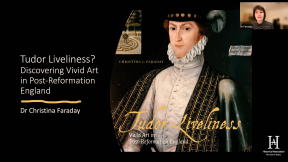
In Tudor England, artworks were often described as ‘lively’. What did this mean in a culture where naturalism was an alien concept? And in a time of religious upheaval, when the misuse of images might lure the soul to hell, how could liveliness be a good thing? In this talk...
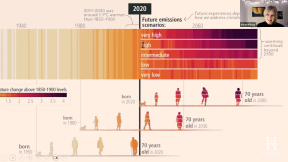
How might we integrate a focus on our relationship with the natural world through time in our existing curriculum? Why should we teach about key turning points in human history that have shaped this relationship in profound ways? What is history's role in explaining how we got to this point?...
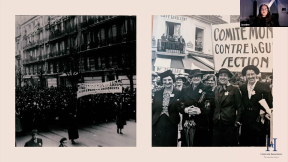
How did a group of women activists with varied ideological backgrounds construct several important campaigns against fascism in the interwar period? How did this Women's World Committee against War and Fascism (Comité Mondial des Femmes contre la Guerre et le Fascisme) undertake effective humanitarian and propaganda work and forge extensive...
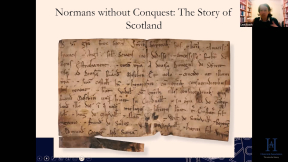
How did descendants of Viking marauders come to dominate Western Europe and the Mediterranean, from the British Isles to North Africa, and Lisbon to the Holy Land and the Middle East? In this Virtual Branch talk Levi Roach, author of Empires of the Normans, tells a tale of ambitious adventures...
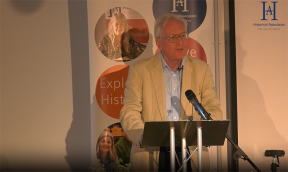
The Medlicott Medal is awarded annually for outstanding services and contributions to history. This year the Medal went to renowned historian and author Professor Diarmaid MacCulloch who is currently Professor of the Church at Oxford. His 2008 book History of Christianity: the first three thousand years is the leading authority...

According to HA surveys over the years we know that supporting non-specialist teachers to teach history is a concern. In fact almost a quarter of respondents in previous surveys have expressed concern about the amount of history being taught by non-specialists. Given the current crisis in teacher recruitment and budgetary...