

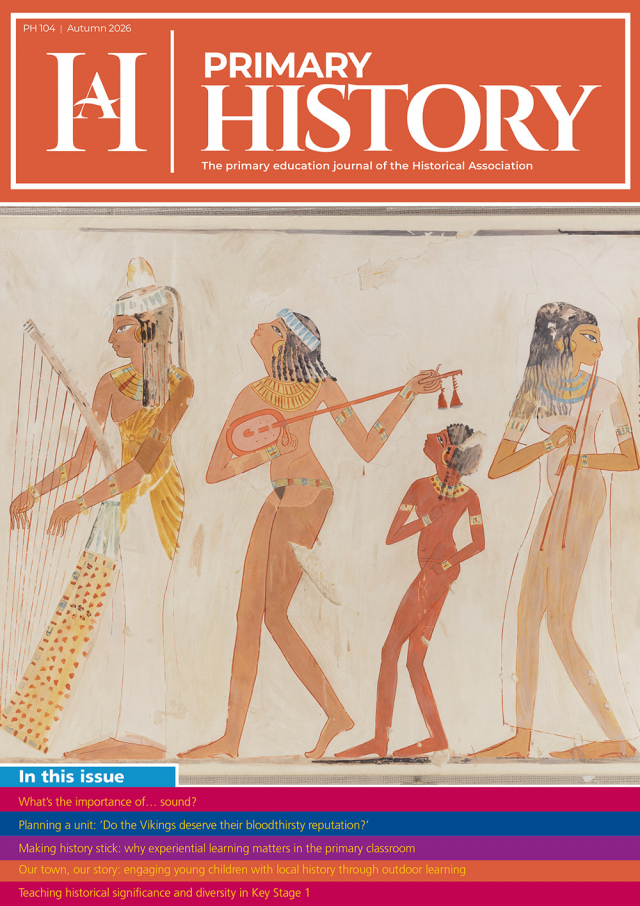
Primary History 104: Out now
The primary education journal of the Historical Association
Editorial
I think the autumn term is one of my favourite periods. It heralds the start of a new school year as we return, refreshed, to the learning journey. It is also the term of festivals and remembrance.
We start with the festival of harvest. For many of us today, living in urban centres, we pay lip service to the idea of gathering in the produce from field and farm. This is a time of celebration and thanks, both for the Christian harvest festival and for the Jewish Sukkot. For communities in the past, however, this was a crucial point of the year – the culmination of the year’s labour. If the harvest was not good, then the family faced the real prospect of starvation over the winter months. As we face the need to consider food security, and as climate change threatens to recalibrate our world’s balance, perhaps we need to refocus on the importance of harvest and agriculture.
This is also a term for remembrance. Over October, we will celebrate the arrival and contribution of the Black British community, focusing on our long shared past through a range of stories. While no longer an official holiday, we will continue to commemorate the possibility of treachery and overthrow encapsulated in the Gunpowder Plot and Bonfire Night. Later in November, we will take part in the solemn national ceremony of remembrance for those fallen in and affected by war.
At the end of term, the darkness of the winter months will be pierced by light as we celebrate Diwali, Hanukkah and Christmas. These festivals and ceremonies bring us together as families, communities and nations, reminding us of the importance of memory and history.
In this edition, we look at how to introduce our youngest children to the idea of history encountered through our families in Helen Matt’s article, while Lynsey Hood and Joanne Smith provide some ideas for exploring Remembrance Day with young children. Caroline Cartmill shares the experience of learning about how to teach the subject of the Holocaust and celebrating a significant individual is considered by Charlotte English. Scott Cairns, Jen Bowditch and Kerry Sommers share examples of their own classroom activities, Jenny Wilkie suggests how we might work with local and national museums. Helen Crawford and Anjana Rajagopal show how we can celebrate achievement in history through display. Finally, Susie Townsend invites us to consider how sound and music provide exciting possibilities for a different theme of history.
We wish you all a fruitful and mindful autumn term with an exciting term of heritage and history before you.