Religion

In this section religions, religious belief and many elements of religiosity are explored and discussed. Early pagan beliefs in Britain and Ireland to the worship of gods across Europe are explored as are the religious changes that monotheism introduced. How religion affects themes of power, individuality and architecture are debated as are key historical movements such as the Reformation and the crusades.

Sort by: Date (Newest first) | Title A-Z
Show: All | Articles | Podcasts | Multipage Articles
  • Regional Aspects of the Scottish Reformation

    Article

    Reformation Perspective In recent years studies of the Scottish Reformation have undergone a marked change. Religion is seldom advanced as the sole mainspring of the events of 1560 and explanations have been increasingly sought in political and economic terms. On the political side growing opposition to French influence within Scotland...

    Click to view
  • Religion and Party in Late Stuart England

    Article

    The second English Revolution of the seventeenth century, the Revolution of 1688, ushered in during the next twenty-five years a series of changes which were to be profoundly important to the ultimate development of the country. Most conspicuously, the reigns of William III and Anne released Englishmen - though not...

    Click to view
  • Religion and Politics 1559-1642

    Article

    It is a truism to say that religion and politics were inextricably mixed in the seventeenth century. "So natural" wrote Richard Hooker,"is the union of religion with Justice, that we may boldly deem there is neither where both are not" Sir John Eliot observed that in the House of Commons...

    Click to view
  • Religion and Science in the Eighteenth Century

    Article

    Much has been said about the clash between religion and science in Victorian times but there has been less research into the relationship between them in the eighteenth century. This article considers three Georgian clergymen who were also notable scientists – the Reverend William Stukeley, the pioneer of scientific field...

    Click to view
  • Sacred waters: Bath in the Roman Empire

    Article

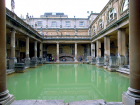
    Eleri Cousins explores the dynamics of Romano-British religion at the sanctuary at Bath. What do you think of when you think of Roman Bath?  Most of us probably think of, well, the Baths – in particular the iconic image of the Great Bath, with its Roman swimming basin and its...

    Click to view
  • Secular acts and sacred practices in the Italian Renaissance church interior

    Article

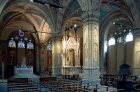
    Joanne Allen reveals a fundamental structural and architectural development in Italian churches in the Renaissance era, demonstrating that careful observation of structures and archives can substantially inform our appreciation of all church buildings.  In the opening to The Decameron (c. 1350), Boccaccio described how the ten young people who would become storytellers...

    Click to view
  • St Theobald of Provins and evidence of charcoal-burning

    Article

    Trevor James has been researching the ‘saintly landscape’ for over 40 years. Here is a glimpse of what he has identified.

    Click to view
  • The 1620 Mayflower voyage and the English settlement of North America

    Article

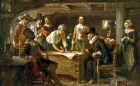
    On the 400th anniversary of the arrival of the Pilgrims in New England on the Mayflower, Martyn Whittock explores the reasons for migration to the New World in 1620 and later, and the significance of those migrants, both at the time and their impact on the evolution of the USA...

    Click to view
  • The Albigensian Crusade

    Article

    At the time of the First Crusade southern France was strongly Catholic: the army led by Raymond IV of Toulouse was the largest single force to take part in the expedition and was recruited from all classes. Yet eighty years later the Count's grandson, Raymond V, sent this appeal form...

    Click to view
  • The Aztec Empire: a surprise ending?

    Article

    Matthew Restall explores current ideas about the end of the Aztec Empire. For an empire that existed half a millennium ago in a hemisphere far away, we have a remarkably clear sense of what brought the Aztecs down. Or at least, we think we do. Our general assumption is that the very nature of...

    Click to view
  • The Borgia: from fact to fiction

    Article

    For their meeting in September 2017 the Bolton Branch requested a talk on Renaissance Italy. What they heard dealt with the Italian portion of the Borgia family, led by Pope Alexander VI, though the topicality of Catalan nationalism meant that the principal figures were introduced with comment on the Italian,...

    Click to view
  • The British Empire on trial

    Article

    In the light of present-day concerns about the place, in a modern world, of statues commemorating figures whose roles in history are of debatable merit, Dr Gregory Gifford puts the British Empire on trial, presenting a balanced case both for and against. In June 2020 when the statue of slave-trader Edward Colston...

    Click to view
  • The Byzantine Empire on the Eve of the Crusades

    Article

    This resource is a pamphlet titled ‘The Byzantine Empire on the Eve of the Crusades’ and written by R. J. H. Jenkins in 1953. As such, some of the scholarship has been updated since then, although it can provide useful historiography. It is not strange that there should in recent...

    Click to view
  • The Christian Kingdoms of Nubia and Ethiopia

    Article

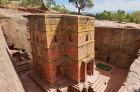
    Adam Simmons draws our attention to the need for further research into the relationship between the medieval Kingdoms of Ethiopia and Nubia – a fascinating time and place in African history which is neglected in the historical archive and about which, so far, there are only limited sources. The kingdoms of Ethiopia...

    Click to view
  • The Establishment of English Protestantism 1558-1608

    Article

    The Reformation which Queen Elizabeth and her ministers created was a series of acts of state, but if we consider it only at the level of official hopes and pronouncements, we will paint a picture of hopeless unreality. For the Reformation to success, the government needed to follow up its...

    Click to view
  • The First Crusade

    Article

    Nine centuries after enthusiasm for pope Urban's expedition to Jerusalem swept western Europe the phenomenon of the first crusade continues to fascinate. This pamphlet examines the nature of the crusades and the motives of those who joined it, describes the hardships of the long journey to the Holy Land and...

    Click to view
  • The First Crusade, 1095–99

    Article

    As Christianity had spread across Europe, Islam had spread across the Middle East. At the end of the eleventh century the relationship between the Muslim leader of Jerusalem and the Christian communities and travellers to the city fractured. Along with other key relationships across Europe, the Middle East and around...

    Click to view
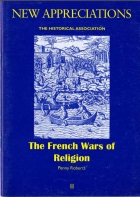
  • The French Wars of Religion

    Article

    This classic pamphlet takes you through the French reformation, the first, second and third war of religion, The St Bartholomew's Day massacre and the Fourth War, the later wars, the Catholic League, Henry IV, the nobility, the towns, confessional violence, social contexts and warfare and its costs.

    Click to view
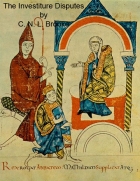
  • The Investiture Disputes

    Article

    Historical labels are dictated by a wayward fashion; and the name which is still most commonly associated with the first struggle of Empire and Papacy (1076-1122). "The Investiture Disputes," is neither lucid or appropriate. It has been commoner for historians to name the great wars of history after the issues...

    Click to view
  • The Jews of Medieval England

    Article

    The diversity of the history of the British Isles continues to be a subject of discussion in academic circles and in popular culture. Some communities have been around for hundreds of years, while others have been part of our societies and then disappeared or been eroded. One of the communities...

    Click to view