

Commemorating the First World War at Sea
History journal blog post
This blog post complements the first view publication of the author’s History journal article: ‘The First World War at Sea: Death, Commemoration and Cultural Remembrance’.
Writing in November 1926, a correspondent for The Nottingham Evening Post reflected that ‘nobody needs to be reminded that at 11 a.m. on Armistice Day a silence drops over the country from Land’s End to John o’ Groats, from North Uist to South Foreland, that not a wheel turns, not a man or woman speaks, but sits or stands – with bowed head and full heart’. While Armistice Day was firmly established in the nation’s civic calendar, the correspondent noted that the annual event, both ‘in London and in many of the great cities’, becomes ‘more and more dedicated to the military section of those who made the great sacrifice’ during the First World War. While he felt it would be ‘unjust to say that the sailor is excluded’, the correspondent lamented that Britons were a ‘careless people’ and that the ‘memory of the soldier has, at the expense of the sailor, taken first place in the thoughts of the public at large’.1
The correspondent for The Nottingham Evening Post was not alone in expressing such concerns. Shortly after the burial of the Unknown Warrior in November 1920, the newspaper proprietor Horatio Bottomley, who had attended the ceremony, felt a ‘sense of incompleteness … in the end it was decided to call him an Unknown Warrior, but we knew him to be a soldier-warrior.’ Britain, he regretted, was ‘apt to forget the sailors’.2
The apparent marginalisation of the sailor in the post-war commemorative landscape is in some respects unsurprising. The roughly 45,000 Royal Navy personnel who died during the conflict, alongside approximately 15,000 who lost their lives while serving on British merchant and fishing vessels, paled in comparison to their counterparts in the trenches and on the battlefield. Indeed, they comprised only a very small fraction of the estimated 722,785 British servicemen who died during the war.3
More broadly, the Royal Navy’s failure to achieve a decisive, Trafalgar-style victory during the conflict, a series of post-war naval disarmament treaties, and growing anxiety surrounding the destructive potential of the aeroplane compounded wider fears that the Royal Navy was being ‘lost to view and forgotten’ and that a generation was ‘growing up totally ignorant of its characteristics and its work’.4
Nevertheless, a diverse and influential series of remembrance practices were, in fact, established (and adapted) after 1918 to incorporate the memory and lived experiences of those who died at sea – at least in the case of white British sailors – into wider memorial and national narratives.
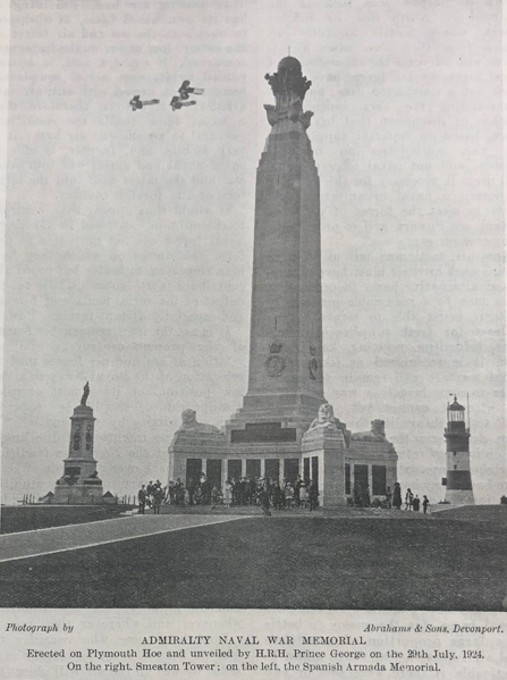
Most visibly, monuments and memorials were erected to commemorate the Royal Navy, the Mercantile Marine, and others with no known grave. Naval memorials were established in Portsmouth, Plymouth, and Chatham – the three manning ports during the First World War – although monuments were also built in the nation’s capital and on a local level throughout the country. Days of remembrance including Jutland Day, Zeebrugge Day, and even Jack Cornwell Day were also instituted, while existing rituals such as Trafalgar Day – traditionally devoted solely to Nelson and the Battle of Trafalgar – became increasingly democratised to memorialise the ordinary sailor.
Alongside monuments, memorials, and annual days of remembrance, naval processions, pageants, re-enactments, and ‘battle reconstruction’ films of key First World War naval engagements were staged across the country. This included largely triumphalist recreations of the Battles of Coronel and Falkland Islands, the Battle of Jutland, and the Zeebrugge Raid, although displays of coastal bombardments, Q ship and submarine engagements, and even the sinking of the Lusitania were also re-enacted. Such displays elicited contrasting public responses, ranging from pride and patriotism through to unease, anger, and even horror.
Completed thanks to a History Early-Career Research Bursary, my recent article examines the place of the sailor and the sea in the post-war commemorative landscape and, in doing so, uncovers much about the contested and complex legacies of the First World War, the ongoing resonance of the navy in post-war popular culture, alongside the broader impact of war on British society and culture. Far from being ‘forgotten’ or ‘neglected’ as some contemporary observers feared, there was a widespread desire to commemorate those who, rather than losing their lives on the battlefield or in the trenches, had ‘no other grave than the sea’.5
References
1. Nottingham Evening Post, 10 November 1926.
2. Sunday Mirror, 14 November 1920.
3. Jay M. Winter, The Great War and the British People (rev. edn; Basingstoke, 2003), pp. 71–3.
4. Daily Mail, 4 July 1929.
5. The Times, 30 July 1924.