

Songs for Ghosts*
By Clara Kumagai (Bloomsbury Publishing)
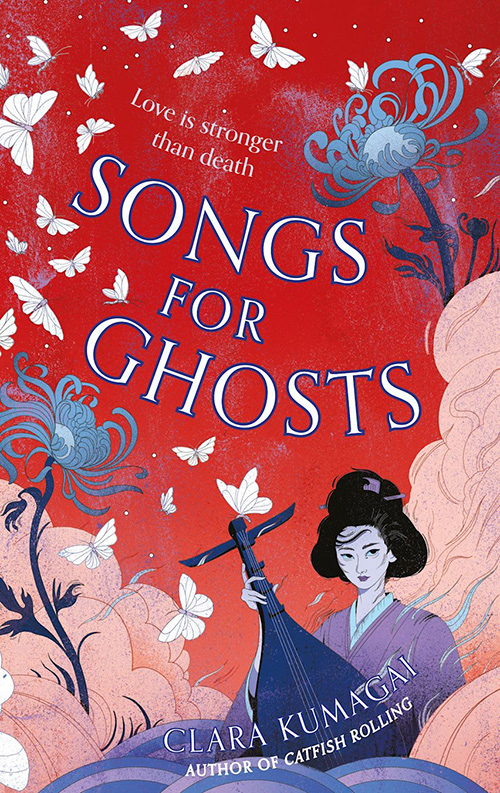
*Shortlisted
Review by Leila, Riverside School
Favourite quotes:
“Trailing love and hurt and longing across decades”
“A dramatic ceremonial sound announcing the death of my relationship”
The fact that it was set in modern-day America and Japan however key aspects of the story were based in around 1945 Japan was interesting as it was a topic that I did not previously know much about. I learnt many new things about this book especially the tradition called Okinawa where the dead and living are celebrated much like in other countries.
I found Kiku the most interesting as we get to see her life through the diary that she wrote, for me this reflected the many other lives that were lost and forgotten in the atomic bomb. I also admired her courage and bravery while communicating with ghosts.
However, I disliked how Adam’s father and Kate suddenly appeared at Adam’s gig in the middle of Japan especially considering that Adam’s dad has a very strict job and they were not invited but main issue was still not properly addressed. The same issue occurs with Evan as we never get closure.
This book has inspired me to learn more about the lives of people in Japan before and after the atomic bomb.
I would recommend this book to students that enjoy history and relationship drama as this book has plenty of both aspects.
Review by Ava, Richard Lander School
As someone who is interested in Japanese history and culture, I found song for ghosts by Clara Kumagai enticing and emotionally impactful. What I appreciated most was how the novel didn’t just tell a story but also acted as a bridge between past and present, showing how history continues to shape people’s identities.
The book follows Adam, who discovers a diary connected to Nagasaki: which was a topic I’ve always found fascinating from a psychological and scientific perspective, and I thought this was one of the strongest parts of the novel. Instead of presenting history in a dry or purely factual way, Kumagai weaves it into the narrative so that it feels alive and personal. It
made me think more deeply about Nagasaki not just as a place associated with World War II, but as a city with a long history of cultural exchange. Both a powerful imperialist axis power but also a home to millions of people with their own cultural identity.
Even though the atomic bombing isn’t the main focus, I felt like its historical weight is always present in the background. Knowing what Nagasaki would later go through adds a layer of dramatic irony and sadness to the earlier timeline. For me, this made the story more powerful because it shows how places carry memory, even across generations.
I also found the novel quite didactic, but in a positive way. It taught me about aspects of Japanese history and society without feeling like a textbook. Instead, the lessons come through the characters’ experiences and emotions, which made them much more memorable. The use of ghosts was especially interesting to me. not just as a supernatural element, but as a symbol of how the past lingers and demands to be understood.
From a personal perspective, I liked how the book explores identity, especially for someone like Adam who feels caught between cultures. This connected to the historical themes, as it shows that identity is often shaped by history, whether we realise it or not.
Overall, I think song for ghosts is a really effective blend of historical fiction and supernatural storytelling. It deepened my understanding of Japan and Nagasaki, while also making me reflect on the importance of remembering history. As a student who enjoys history and reading in my spare time I found it both educational and engaging.
Review by Fatima, Archbishop Temple Church of England High School
I really liked Song for a Ghost because it’s not your typical, boring history book—it’s actually pretty dark and moody. It has this heavy, haunting vibe that reminds me of my Year 8 "silent era" when I spent more time watching everyone from the shadows than actually joining in. The way the author describes the past makes it feel like a cinematic mystery rather than just a list of dates, which is why it felt so serious and thought-provoking to me. I’d definitely recommend it to anyone who likes stories that feel a bit "ghostly" and deep, almost like those sad, quiet scenes in a drama where the music just hits different. It's the kind of book that stays with you because it captures those hidden feelings people don't usually talk about.