
Historian articles
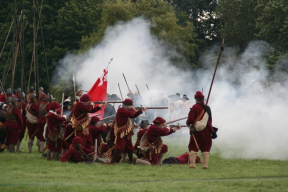
In this article Geoffrey Carter will be taking a look at battlefields as key elements in British history and how these can be incorporated into the study of history at various levels and in various periods. The regional nature of many historic conflicts is sometimes forgotten but this is an...
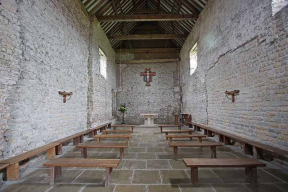
Marie Paterson discovered this historical and spiritual structure many years ago and it continues to affect her. In Essex, on the northern shore of the Dengie Hundred, overlooking the mouth of the Blackwater estuary, proudly stands the lonely Saxon chapel of St Peter’s-on-the-Wall. Erected on the site of the Roman...
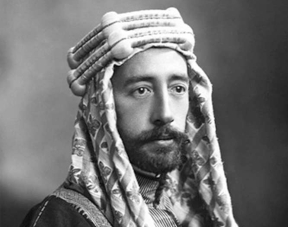
Paula Kitching reveals how a secret diplomatic negotiation 100 years ago provides an insight into the political complexities of the modern-day Middle East. The Middle East is an area frequently in the news. Over the last ten years the national and religious tensions appear to have exploded with whole regions...
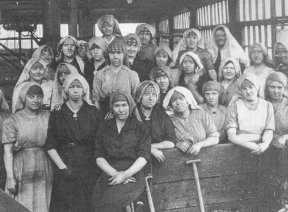
With the final closure of Britain’s deep coal mines, Chris Wrigley examines the long-standing involvement of women in and around this challenging and dangerous form of work. With the closure in 2015 of Thoresby and Kellingley mines, the last two working deep coal mines in Britain, leaving only open-cast coal...
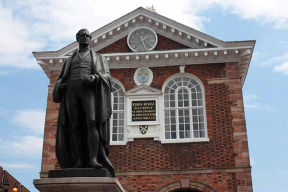
Trevor James introduces the wider context in which Tamworth’s history has developed. Modern-day visitors to Tamworth immediately observe its very extensive out-of-town shopping areas and industrial estates and then, in stark parallel, notice that the signage is welcoming them to the capital of historic Mercia. Investigating this conundrum is the...
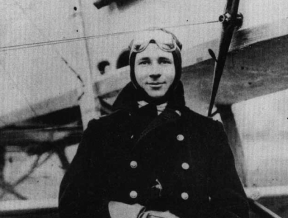
Ronan Thomas introduces the bravery of Rex Warneford who was the first pilot successfully to bring down a Zeppelin in 1915. Rex Warneford was one of Britain’s ‘bravest of the brave’. A Royal Navy fighter pilot during the First World War, he was awarded the Victoria Cross by King George...
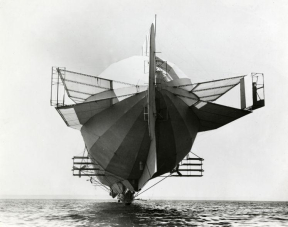
In the First World War Britain suddenly became vulnerable to aerial attack. Alf Wilkinson records a memorable turning-point in the battle against the Zeppelin menace. On the night of the 2-3 September 1916 Lieutenant William Leefe Robinson became the first pilot to shoot down a Zeppelin raider over Britain. He...
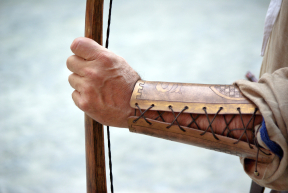
Adam Chapman debates the evidence for a Welsh presence among Henry V’s highly-successful force of archers at Agincourt in 1415. Michael Drayton, in his poem of 1627, The Bataille of Agincourt, described the Welsh presence in Henry V's army: ‘who no lesse honour ow'd To their own king, nor yet...
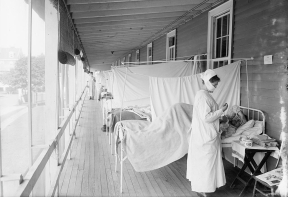
In our continuing Aspects of War series Hugh Gault reveals that the flu pandemic, which began during the First World War, presented another danger that challenged people’s lives and relationships. Wounded in the neck on the first day of the battle of the Somme, 1 July 1916, Arthur Conan Doyle’s...
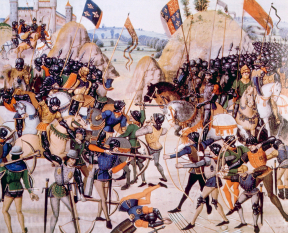
In the tradition of landscape historians, Peter Hoskins has explored some of the route marches taken by English armies during the Hundred Years War. After the battle of Crécy in 1346 and the capture of Calais by Edward III in the following year the Hundred Years War settled into an...
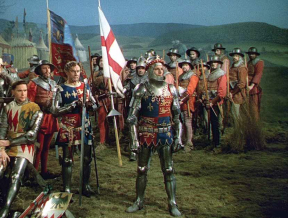
Public attitudes to Henry V are very much influenced by WilliamShakespeare's interpretation. Richard Inverne discusses howShakespeare's version has been translated into cinematic form byLaurence Olivier and Kenneth Branagh. Shakespeare indulges himself considerably with his own relatively recent history - Richards II and III, Henrys IV, V and VI, for example....

Our perspective on how archers performed in battle is enhanced byMark Hinsley's research into their use of protective stakes. On the approach to Agincourt in 1415 a small skirmish took place at Corbie, on the Somme. A force of French men-at-arms sallied out from the town and cut up some...
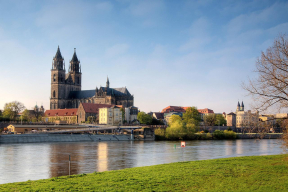
Magdeburg (‘Magdeburg überascht') is situated on the banks of the River Elbe in the state of Sachsen-Anhalt, Germany. First mentioned by Charlemagne in 805, Magdeburgtoday attracts much attention by being a major historic venue on the Straße der Romanik or Romanesque Route that has opened up a large number of...
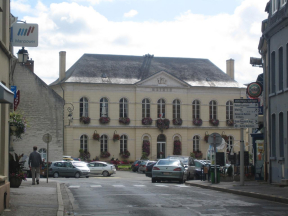
John Painter explores a strategically-important French boundary town, over which neighbouring powers have competed for over 1,200 years. Montreuil in Picardy is one of the most interesting small towns in northern France and a good base for visiting the battlefields of Crécy and Agincourt as well as the Somme Western...
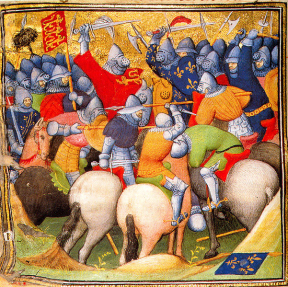
Agincourt has become one of a small number of iconic events in our collective memory. Anne Curry explores how succeeding generations have exploited its significance. In his budget statement of 18 March 2015 the Chancellor of the Exchequer, George Osborne, announced £1m had been awarded to commemorate the 600th anniversary...

Paul Brunyee asks why Napoleon ended up on St Helena, and what life was like for him in exile there. On his return to Paris after Waterloo, Napoleon had no significant group of supporters left in Paris. He was stunned by his catastrophic defeat and knew he was being outmanoeuvred...
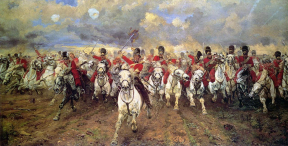
John Morewood explores the events of 18 June 1815 in detail and asks just how accurate is our view of what happened on the field of Waterloo. Summary Waterloo is the most famous battle in a four-battle campaign fought from 15 June to 19 June 1815. On one side were...
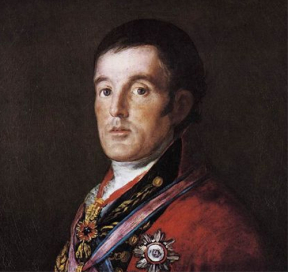
Scum of the earth – or fine fellows? Carole Divall asks whether the men of the British Army really were ‘the scum of the earth’, as often asserted, or willing soldiers who earned the respect of the French. ‘Soldiers were regarded as day labourers engaged in unsavoury business; a money...
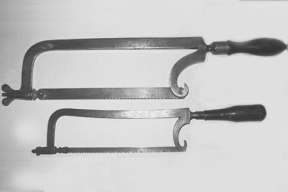
Michael Crumplin explores the medical facilities of the British Army and asks how likely soldiers wounded at Waterloo were to survive. The road to Waterloo One of the very few benefits of conflict is the advancement of medical practice. The recent wars in Iraq and Afghanistanhave been dealing with relatively...
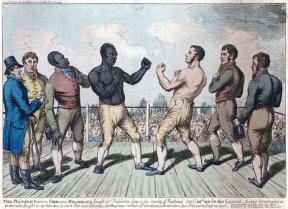
Image: 'Pierce Egan celebrates the Boxiana touch as Napoleon is floored' David Snowdon examines the impact of the world of ‘pugilism' on the army during the Napoleonic Wars and looks at some famous boxers who perished in the battle. By 1815, one writer, and one sporting publication, had become synonymous...