

Women’s History Month 2026
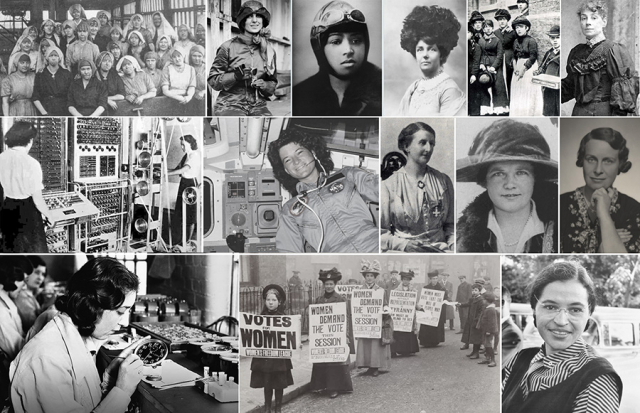
March is Women’s History Month, which conveniently overlaps with International Women’s Day (IWD). This year’s IWD has the theme 'Give to Gain', emphasising that providing resources and opportunities to women and girls benefits everyone: ‘When women thrive, we all rise’. Where has this message come from? From the real-life experiences of women over generations, which is of course history.
Women have always made up half of the global population (give or take), but have long been hugely underrepresented in recorded history – and in history education. That’s largely of course because most societies have not historically granted women equal status with men socially, politically, economically or in the breadth of roles women have been allowed to fulfil. It’s also because, until relatively recently, most histories have been written by, for and about men (and predominantly white men of a particular social class and standing).
For many, our awareness of women’s history is still largely limited to a handful of famous queens, suffragettes and campaigners, plus the occasional Florence Nightingale, Marie Curie or Amy Johnson. And with rare exceptions like Rosa Parks and Mary Seacole, these have again mostly been white individuals of a certain social class.
This Women’s History Month, in addition to celebrating those individuals, try and support the IWD theme and look for the names or evidence of the women who worked together to create a better society for everyone.
The history of Women’s History Month
Women’s History Month originally grew out of a local Women’s History Week started in 1978 by a group of California educators to address gender inequality in school curricula. The idea quickly gained recognition, and in 1980 US President Carter designated the first week of March as National Women’s History Week. From 1987 this expanded to a month-long US observance, now internationally recognised – though not adopted in the UK until March 2011, the centenary of the first International Women's Day in 1911.
The Historical Association has been championing women’s history since long before 2011, along with the histories of even less represented groups. We are also passionate advocates for the inclusion of women’s history throughout the whole year and the whole history curriculum. However, there is still a long way to go before any kind of equality in representation is reached. Last year’s ‘End Sexism in Schools’ research report highlighted that the actions, contributions, experiences and names of women are still too often marginalised in history lessons in favour of the male voice and experience.
Until that changes, Women’s History Month will continue to be a useful springboard and starting point for the inclusion of women in history, and recognition of the (often unseen) contributions women have always made to society.
New film: Proto-feminism in Britain and Ireland – 1714-1785
For 2026 we have commissioned a short film with Dr Mary Jo MacDonald of the University of Jyväskylä. Dr MacDonald explores how the end of the Licensing Act, sweeping political change, and a revolution in intellectual culture opened unprecedented opportunities for women to shape political, social, and intellectual life in Britain and Ireland. The film highlights major proto‑feminist thinkers of the late 17th and 18th centuries, including Judith Drake, Mary Astell and Margaret Cavendish. It also celebrates the 'Triumvirate of Wit': Aphra Behn, Eliza Haywood and Delarivier Manley, whose works shaped early party identities and pushed women into the centre of public debate.
Women’s history resources
We have a huge range of women’s history resources on our website, available for free to HA members – below is a selection to whet your appetite. Our Women's Suffrage database, podcasts and resources are open access year-round.
General resources
- Eastern Nigeria market women and European businesses in colonial Nigeria 1900–29 - open access for March
- The lives and crimes of Irish immigrant women in 19th and early 20th-century America - open access for March
- Real Lives: Anna Wessels Williams (1863–1954): forgotten pioneer of microbiology - open access for March
- Female protagonists in early East India Company history
- Mabel Mercer: the eighth wonder of the world
- Taj ul-Alam Safiatuddin Syah: a trailblazing Islamic queen
- The right to fight: women’s boxing in Britain
Secondary resources
- ‘It’s not just men that do extraordinary things’: using Femina to reframe Year 7 pupils’ understanding of the medieval world - open access for March
- Telling rich stories about women’s lives in the American West at GCSE - open access for March
- Connecting past and present through the lens of enduring human issues: International Women’s Day protests - open access for March
- Shining a light on Eastern European history with Jadwiga of Poland
- Using the story of Eunice Foote to bring environmental history into the curriculum
- How representing women can convey a more complex narrative of the Russian Revolution to Year 9
Primary resources
- She sells seashells by the seashore: teaching Mary Anning at Key Stage 1 - open access for March
- The Brontë sisters: teaching local history through a focus on one remarkable family - open access for March
- Women and space: reaching for the stars - open access for March
- Dora Thewlis: Mill girl activist - open access for March
- Primary History summer resource 2025: Women with power
- Who were the Greeks and how diverse was their society?
- Significant people: Mary Wollstonecraft
Resources available to all HA members:
Recorded talks and webinars
- Recorded webinar: Indian Suffragettes: women's activism in South Asia and beyond - open access for March
- Recorded webinar: Revisiting the witch trials
- Virtual Branch recording: The Women of the Anarchy
- Virtual Branch recording: Poet, Mystic, Widow, Wife – lives of medieval women
Podcasts
- Early British Women engineers - open access for March
- UK Women's Movement
- Women in the Crusades
- Women & gender in medieval Islam
- Women in the US Peace Movement
- Women & gender in the French wars
- British Women 1500-1700
History journal archive*
- Special issue: women and the making of history
- ‘Feet on the Ball, Minds on Their Rights’: Women, Football and Protests in Eastern Nigeria, 1892–1975
- Narratives of Women: English Feminists of the 1790s
- Women's Place in the American Labour Force, 1870–1995
- Women and Patronage in the Late Victorian Army
- Gendering Mobility: Women, Work and Automobility in the United States
- Jenner's Ladies: Women and Vaccination against Smallpox in Early Nineteenth-Century Britain
- The Women at Peterloo: The Impact of Female Reform on the Manchester Meeting of 16 August 1819
*All HA members have access to all History journal articles (Wiley Online Library site). To access History content:
1. Sign in to the HA website (top right of any page)
2. Then click this link to allow access to History content on the Wiley site.
NB all History journal links go to the Wiley Online Library site and open in a new window or tab.