

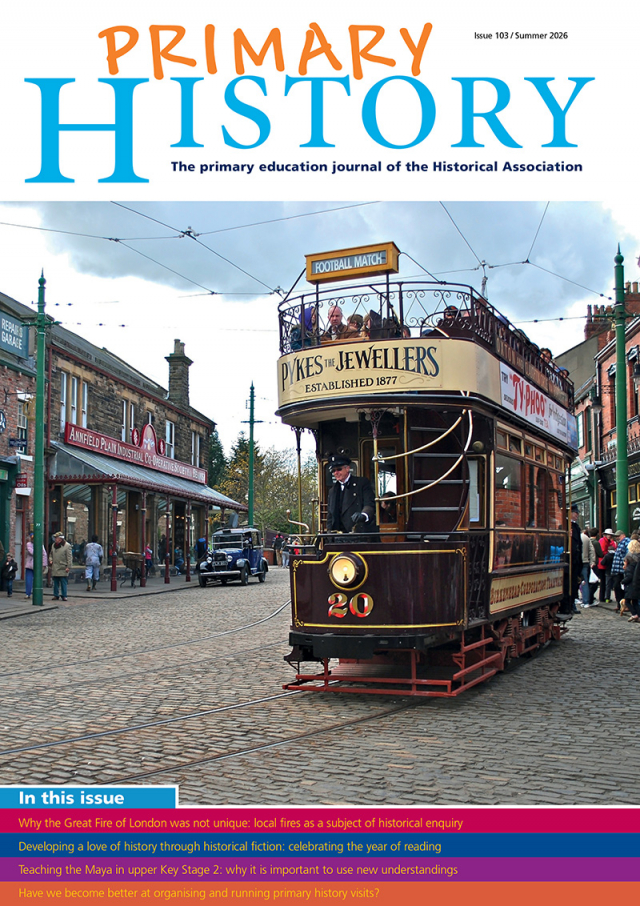
Primary History 103: Out now
The primary education journal of the Historical Association
Editorial
This edition appears too early to reflect the National Curriculum history refresh. Although this is being done by a team co-ordinated by the Historical Association and colleagues are already busy, there seems no point in giving in to speculation and idle gossip. The changes will be evolutionary rather than revolutionary and will be amply covered in future editions of Primary History.
One thing is certain though. No refresh is going to sweep away what is widely recognised as good practice in primary history. It means that this edition is hopefully continuing the tradition of supporting teachers to deliver exciting history learning experiences right across the EYFS to Year 6 age range.
The editorial board have a number of criteria when commissioning or receiving articles for the journal. Not the least is balance – of age group, theme and aspect. Secondly, is it rooted in reality. Do the ideas and suggestions chime with the realities of the busy primary classroom? That is why we encourage quality case studies with a proven track record. Thirdly, while reinforcing good practice that is already well tried, we can always find space for something innovative and different (while still manageable). Also importantly, we know from our range of Historical Association activities that the best practice is not confined to a few practitioners. We come across dozens maybe hundreds of history practitioners doing something rather brilliant in history. We try to identify these practitioners who are often generous enough to share their time and practice in the pages of this journal.
We hope you find that this edition matches those criteria where you will find articles covering EYFS to upper Key Stage 2 including special education, on British and world history, on local history, on planning topics, on conceptual understanding and maybe some tweaking of existing practice. For example, one of the most popular themes in Key Stage 1 is the Great Fire of London. Yet James Bowen reminds us that many other places had catastrophic fires that could also be covered, maybe adding a local dimension to things. The overall aim of all our articles is to share good practice, to challenge, to entertain and reassure that history remains vibrant, popular and important for those in primary schools and settings.