

Teaching History 202: Out now
The HA's journal for secondary history teachers
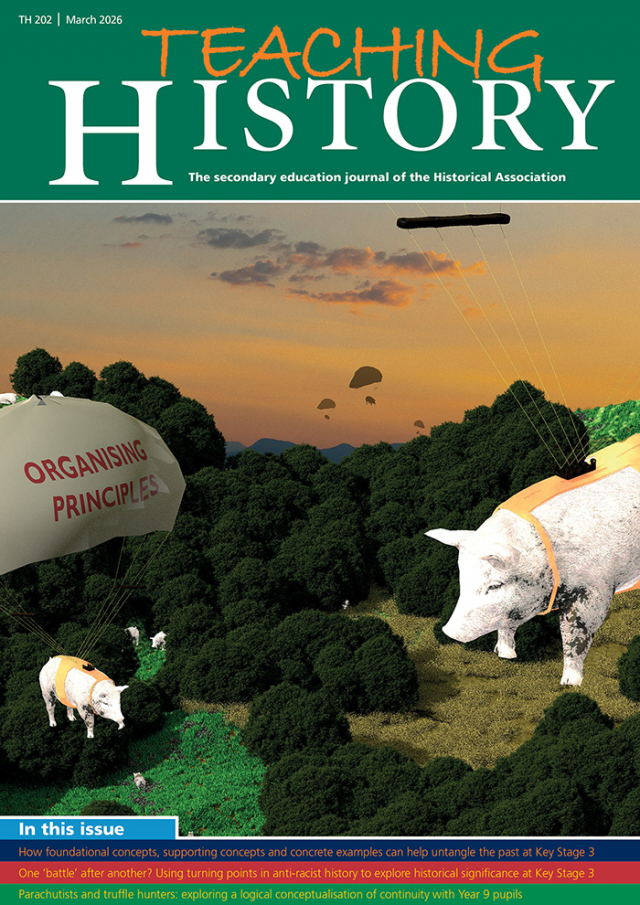
Editorial: Organising Principles
Read Teaching History 202: Organising Principles
Late last year, the government responded to the final report of the Curriculum and Assessment Review, making clear its commitment to revising the National Curriculum for schools in England and promising various reforms to public examinations. As they await new drafts (with publication of the National Curriculum promised for spring 2027, and earliest teaching of new examination specifications set for 2029), history teachers and campaigners alike are looking carefully at what is known about the principles that will underpin the revisions.
One of the most important was set across all subjects and phases: a principle of ‘evolution not revolution’, promising measured reform rather than radical upheaval, but others are specific to history. These include a commitment to developing ‘strong substantive and disciplinary knowledge’ and an intention to strengthen students’ understanding of British history, while ensuring that teachers can reflect ‘the innate diversity’ of that history, ‘including British Black and Asian history’.1 In the government’s more limited focus on the curriculum for examination at 16+ is an acknowledgement of concerns about ‘curriculum overload’ and a call for assessment structures to better support the acquisition of both substantive and disciplinary knowledge.
While there is much yet to be revealed, the process of establishing secure underlying principles for any curriculum design is an essential one. It is also a process on which contributors to this journal regularly report; whether they are reflecting on how the substantive and disciplinary are understood and interwoven in particular enquiries / schemes of work; or re-evaluating the balance of representation across their curriculum; or considering how well specific assessment strategies reflect their ambitions for students’ historical learning.
All these themes are encompassed in this issue’s focus on ‘Organising principles’. The first two articles both engage with the critical question of identifying the essential substantive concepts that underpin or drive their Key Stage 3 curriculum, before layering in the supporting concepts intended to strengthen and secure students’ understanding, and selecting an appropriate variety of specific or ‘concrete’ examples to ‘enrich’ students’ understanding, fleshing out their mental schemas. In explaining his department’s approach to curriculum planning by looking across these three tiers, Gareth Lennon focuses particularly on how they have used different kinds of assessment to check on its effectiveness. Dickins and Alexander emphasise the importance of language and the vital role played by different forms of teacher explanation of substantive concepts, alongside opportunities for students’ own oral and written experimentation with them. They also illustrate how the development of students’ understanding depends on the connections drawn between the different levels, working in both directions from the abstract to the concrete and from the concrete to the abstract.
The authors of the Cunning Plan and a second pair of articles focus attention on a particular disciplinary concept: that of change and continuity. Dan Proctor and Stefan Carron are concerned that treating the landscape as a natural or static ‘backdrop’ to long-term historical processes distorts young people’s understanding of the ways in which even our apparently ‘natural’ surroundings have been historically constructed by human activity over time. Their local enquiry ‘How has the Lake District been shaped over time?’ was designed to make this relationship clear. It also serves to exemplify another fundamental organising principle: the value of an interdisciplinary approach to certain kinds of question, drawing powerfully on key concepts from both history and geography.
Joel Sharples was inspired by a local exhibition to re-think his approach to teaching about the specific concept of a ‘turning point’. The notion of a change in direction is obviously central, implying a profound shift away from an established trend, but the designation of any development as a turning point also implies a judgement of significance. Consideration of criteria often applied in determining historical significance therefore helped Sharples to frame a powerful local enquiry, of national importance in understanding the history of anti-racist struggles in Britain.
Miles Eades, in planning an enquiry about changing attitudes towards British rule in India, was concerned about the harmful effects of students’ misconceptions of continuity as a simple absence of change. He explains the series of premises that he established as the foundation for a more realistic conception of continuity (as a process constituted by ongoing, inter-connected, micro-changes) and illustrates the outcomes on his students’ understanding of planning in this way. The article also reiterates previous contributors’ insights into the power of visual metaphor to support students’ analytical descriptions of patterns of change.
Beyond the issue of how we support and evaluate students’ understanding of substantive and disciplinary concepts, lie questions about how teachers prepare for any curriculum change through the development of their own knowledge. Abigail Branford and Peter Brooke, who share the concerns raised by Alex Benger in Teaching History 187 about the damaging assumptions perpetuated by a ‘balance sheet’ approach to the impact of the British Empire, highlight the importance of taking a longer-term approach to economic histories of Africa and of recognising African agency within them. Their article is intended to support teachers in developing the substantive and disciplinary knowledge that they would need in order to do so.
References
1. Department for Education (2025) Curriculum and Assessment Review Final Report: government response. www.gov.uk/government/publications/curriculum-and-assessment-review-final-report-government-response