

The Historian 169: Out now
The magazine of the Historical Association
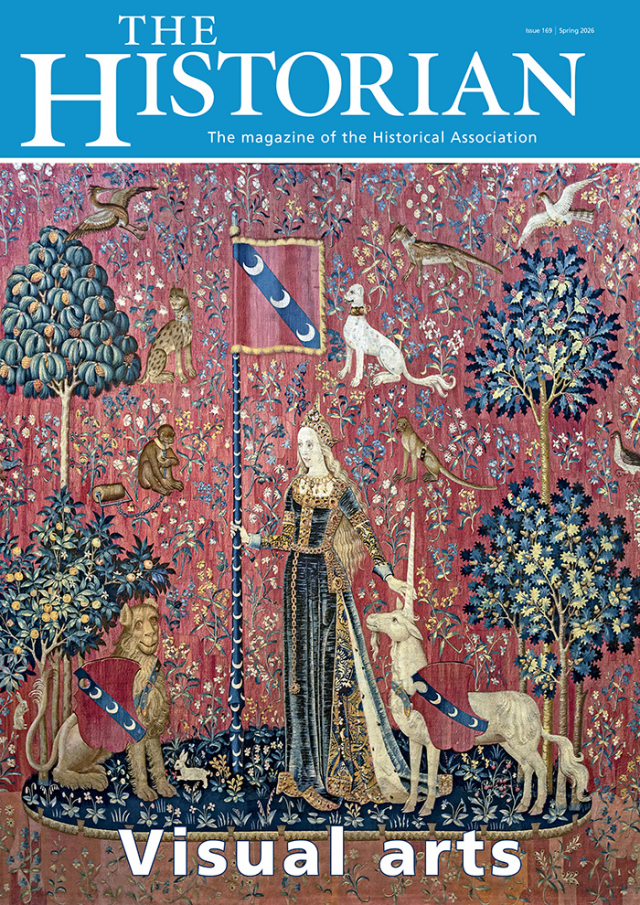
Editorial: Visual Arts
Read The Historian 169: Visual Arts
Long before the development of written language, human societies communicated through images. From prehistoric cave paintings to medieval manuscripts, political cartoons and modern film. The visual arts have long provided a powerful means of recording, interpreting, and sharing human experience. For historians, such material offers a unique window into the past, revealing how people understood their world, what they chose to emphasise, and how they wished events, places, and individuals to be remembered. In doing so, the visual arts help illuminate the ways in which experiences were recorded, how ideas were conveyed, and how collective memory was shaped, reminding us that they are not merely illustrations, but valuable historical sources in their own right.
Visual material is particularly significant in its ability to transcend linguistic and cultural boundaries. Images can communicate ideas, emotions, and narratives in ways that words alone cannot always capture. For this reason, the visual arts have often functioned not only as decoration or entertainment but as important forms of communication and storytelling. Whether created intentionally as records or for entirely different purposes, works of art can reveal contemporary attitudes, identities, and values, offering insight into how the past was seen, imagined, and understood by those who lived through it.
The themed articles in this edition explore the visual arts across a wide range of historical contexts, demonstrating their importance as both sources and agents of historical change. From the symbolic richness of early modern tapestries to portraiture in colonial South America, these studies reveal how images could communicate identity, authority, and meaning in ways that transcended language. Other contributions examine the role of visual culture in shaping belief, particularly during the European witch craze, as well as the shifting place of the arts in modern education and public policy. Together, they highlight how visual material not only reflects the societies that produced it but also actively shapes perceptions, ideas, and historical narratives.
A key theme running through these articles is the agency embedded within visual culture. Images emerge as powerful tools through which individuals and groups could assert identity, influence opinion, and navigate complex social and political landscapes. At the same time, these studies remind us that visual sources must be approached critically, as they can both reveal and obscure aspects of the past, reflecting intention as much as reality.
The non-themed articles include topics on the medieval towers of an Italian commune and the legacy of Viking expansion, alongside a particularly strong selection of History Out and About articles. These take us to sites closer to home, including Castle Cary, a unique Second World War educational initiative in Hertfordshire, and the immersive experience of the Black Country Living Museum. Real Lives follows an intriguing research journey into the author of a nineteenth-century scientific dissertation and insights into Prussian society in the years leading to the Unification of Germany, while Doing History explores the royal visit to Plymouth at the height of the Blitz, told through the Royal Archives held at Windsor Castle.
We hope that you enjoy exploring the articles in this issue and that they encourage you to think about the visual dimension of history in new ways.