

The Historian 170: Out now
The magazine of the Historical Association
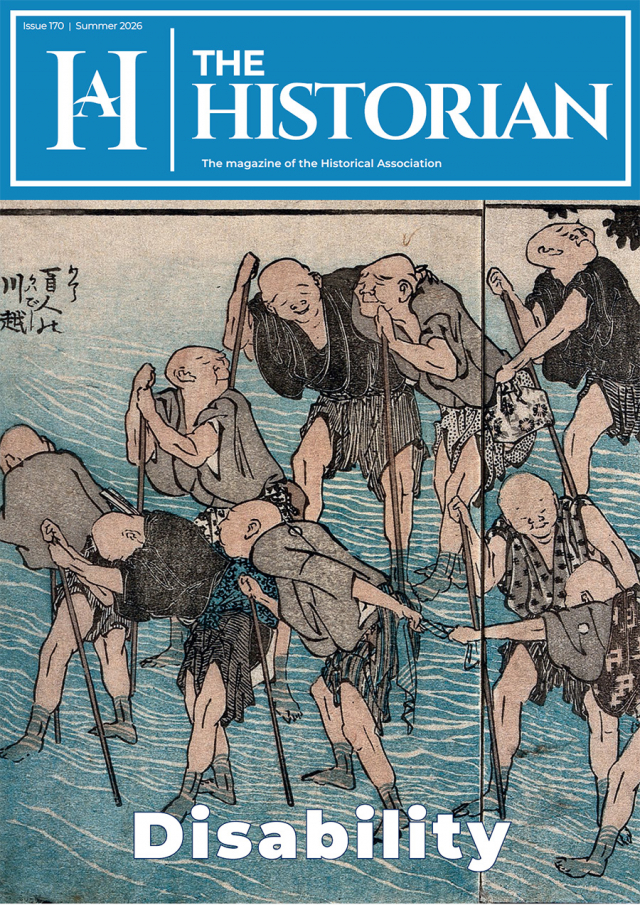
Editorial: Disability
Read The Historian 170: Disability
One of the core aims of historical study is the recovery of the full diversity of the human experience. Since the 1960s, which saw the rise of ‘history from below’, our understanding of past societies has become ever richer through studies of ordinary and often marginalised people, including the labouring poor and working classes, women, gay, lesbian and transgender peoples, people of colour and other ethnicities, and the disabled. The task initially was to locate them. Where better to look than the records of social policy (broadly conceived) and, in the case of disabled people especially, of medical institutions and experts. Under the influence of the cultural turn of the 1980s and 1990s, interest shifted to the representation of marginalised people in sources such as literature and plays, newspapers, and film, radio and television. More recently, historians have focused on the recovery of voices, experiences and agency, in both well used and newly discovered sources.
Today, disability history is an exceptionally vibrant and exciting field of study, and this is why we chose it as our theme for this issue. While so much has been done and achieved over the last 40 or so years, there is still so much to discover and to better understand. We open this themed issue with an Update from Daniel Blackie and Alexia Moncrieff. They describe how studies of disability and disabled people continue to expand into new periods and places, the rise of a new interest in neurodiversity, and the deepening or maturing of the theoretical underpinnings of this increasingly distinct and important field of study. Disability has now become another social category of difference – alongside gender, race and class – which needs to be incorporated into our thinking process when doing history. This is demonstrated particularly well in Esme Cleall’s contribution to this issue, on the importance of a disability history perspective when approaching the history of the British Empire.
Meanwhile, Christopher Thomas Goodwin’s article on disabled Wehrmacht veterans in Nazi Germany shows how continued attention to the relationship between war and disability generates new and important insights, in this case the multiple meanings of the disabled body, and the challenge it posed to Nazi racial ideology. The theme of agency looms large in Rosamund Oates’s article on the use and reception of sign language in pre-modern England, and in Carol Beardmore’s piece on disabled paupers who asserted their rights to relief through letters to the nineteenth century Poor Law authorities.
The story of Harry Drabble, crippled at age two after contracting Bovine TB, is a powerful reminder that despite attitudes and obstacles many disabled people in history led meaningful, purposeful and fulfilling lives. Thriving, campaigning, problem solving and even just being were all forms of resistance which repeatedly challenged normative assumptions about the human experience, as David Turner explains in an interview about his much-anticipated and recently published book, Disability: A History of Resistance. While all this work suggests an accepted and confident field of history, the History UK Report on Disability and History published in late 2025 and summarised by Sarah Holland for this issue maps out crucial work which remains to be done.
As always, we are delighted to include in this issue a diverse range of non-themed articles, including Sean Lang’s piece on representations of empire in the satirical writings of P.G. Wodehouse; Robert Brown’s account of how a spectacular battle re-enactment in London in 1901 turned into a real-life mutiny when the actors insisted on injecting authenticity into the performance; and William Doyle’s rehabilitation of Talleyrand, one of the lesser-known leaders of the French revolution who has too often been dismissed as a self-serving turncoat. We continue to publish prize-winning articles by young historians – in this issue, Isabella Duncan’s piece on the Whitney Blanket Mills and the importance of local history; and fellow editorial board member, Steve Illingworth, provides an account of ‘Doing History’ at The National Archives in Kew, London.
We hope you find this an enjoyable, stimulating and provocative read. We warmly welcome your feedback.