

The Great Debate 2026: Speeches
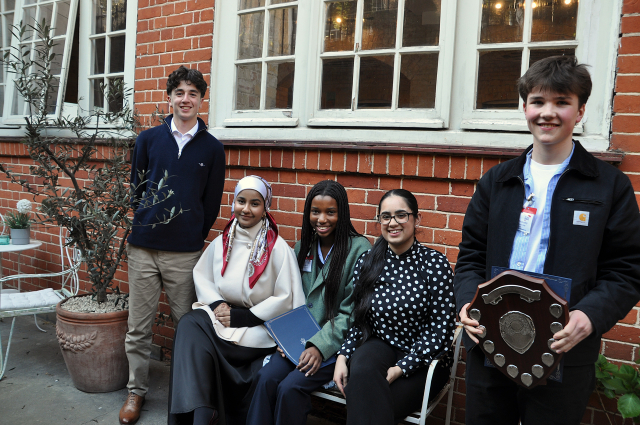
The Great Debate concluded on 21 March 2026 in Central London following a thrilling day. The competition started in the autumn of 2025 with heats running across the UK and online until February 2026. The three semi-finals held online led to the 21 finalists who were invited to London for the final stage with their families present.
Across the day was a wide range of outstanding talks that left most of the audience wondering how the judges were going to choose a winner, a runner up and two Highly Commended from such a strong field. Indeed, it did prove difficult with the judges insisting on having a third runner up just so that they could find a way to agree!
The question that each of the young people all addressed was:
How important are personal and public records as evidence for explaining the story or stories of your local area?
As one of the judges Professor Lucy Noakes said:
“The diversity and range of the histories that we heard about was striking: we were taken from the role of Gaelic in Scottish identity to the impact of Nazi occupation in Jersey; from the aftermath of a Turkish earthquake to a flogging on 18th-century Hounslow Heath, and from a woman imprisoned in a Syrian cell during the civil war to as woman chained in a nineteenth century Barnsley workhouse. We learnt how to read the historic landscape of a Lancashire village and how to trace the histories of fishing in Devon and of the saffron trade in north Essex. Local histories were retold through the eyes and the words of migrants and of the working class while a gendered lens was used to analyse the written histories of an Oxford College.”
At the final the students present their five minute talk to three judges all of whom this year are professional historians led by the Historical Association President Professor Alex Walsham, Professor of Modern History, Cambridge; who was supported by: Professor Lucy Noakes, Rab Butler chair in Modern History, Essex; and Dr Antonio Sennis, Associate Professor of Medieval History, UCL.
Winner:
- Roddy McLuskey, James Gillespie’s High School, Edinburgh
Runner up:
- Duni Kariuki, Cheltenham Ladies College
Highly commended:
- Afeefah Daji, Batley Girls’ High School
- Bilal Nashawi, William Farr School
- Dhaani Singh, Withington’s Girls’ School
The competition is open to students from year 10 to 13 meaning ages throughout the competition, including heats ranges from 15 to 18 years. The competition is in the style of a Balloon debate so they are not arguing against one another but are required to answer the question posed, demonstrate that they have carried out historical research and can provide evidence to deliver their conclusions.
All of those who took part in the final did exceptionally well, with the judges needing extra time to reach an agreement.
- Winner: Roddy McLuskey
- Runner Up: Duni Kariuki
- Highly commended: Afeefah Daji
- Highly commended: Bilal Nashawi
- Highly commended: Dhaani Singh
- Lotte Daniel
- Sathya Vaidyanathan
- Sophie Dinham
- Eliana Kuropatwa
- Ed Turns
- Matey Yordanov
- Rayna Rehman
- Evelynn Higginson
- Alex Catterson
- Zainab Jiva
- Saanvi Vijay
- Artemisia Mameli
- Öykü Demirbaş
- Theo Glew
- Effie Cross
- Isla Rowe