Society

How people group together, organise their rules and systems are all part of what create a society. In this section articles examine the nature of society how it interacts with other themes of culture, power, etc. and how societies have developed and changed over time. The structures of the ancient world are explored as are the complex feudal systems and the varied societies of Empire and modernity.

Sort by: Date (Newest first) | Title A-Z
Show: All | Articles | Podcasts | Multipage Articles
  • Film: Key groups in the African-American Civil Rights Movement

    Article

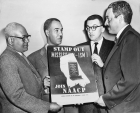
    In this film, Professor Brian Ward and Professor Joe Street of Northumbria University look at two of the key groups that played a significant role in the development of the Civil Rights Movement: the NAACP (The National Association for the Development of Coloured People) and the Black Panthers. If you're unable...

    Click to view
  • Film series: The African-American Civil Rights Movement

    Article

    The US civil rights battles of the latter half of the twentieth century are a common part of popular culture - and yet the detail is often overlooked in favour of the headlines. It is a positive step that so many of us now know the names of Rosa Parks...

    Click to view
  • Ensuring Gypsy, Roma and Traveller children do not feel unseen in the history classroom

    Article

    Richard Kerridge and Helen Snelson present a brief sequence of lessons using the life of the Gypsy woman Mary Squires as a way into the changes of industrialising Britain. More significantly, they also present a compelling rationale for why history teachers should be slotting in the stories of Gypsy, Roma...

    Click to view
  • Do Gypsy, Roma and Traveller children see themselves in your history classroom?

    Multipage Article

    Gypsy, Roma and Traveller people are the largest minority ethnic group in some communities (and therefore in some schools) in the UK.  Richard Kerridge and Helen Snelson have worked with the historian Professor Becky Taylor to produce a range of teaching resources for teaching the history of Gypsy, Roma and Traveller...

    Click to view
  • Film: “The Talk Should Not Be Broadcast”: Homosexuality and the BBC before 1967

    Article

    In the centenary year of the BBC, this Virtual Branch talk from Marcus Collins relates the strange tale of how the BBC did and did not broadcast about homosexuality in the 1950s and 1960s and what it tells us about sexuality, broadcasting and the origins of permissiveness in mid-twentieth century Britain.  Marcus Collins...

    Click to view
  • Secondary Education and Social Change in the UK since 1945: KS3 resource packs

    Multipage Article

    Although secondary education become an almost universal experience for British 11-year-olds after the Second World War, it is striking how rarely this key social transformation is used to engage current school-age pupils studying post-1945 British history. // Can't see the video? Download it here The lessons on these pages are...

    Click to view
  • Teaching Britain’s ‘civil rights’ history

    Article

    Hannah Elias and Martin Spafford begin this article by explaining why they believe it is essential for young people to learn about the ‘heterogeneous, rich and complex’ history of the struggle for civil rights in Britain. Drawing on their diverse experiences of researching, writing and teaching history at school and university...

    Click to view
  • Bringing school into the classroom

    Article

    The Secondary Education and Social Change (SESC) research project team at the University of Cambridge collaborated with four secondary school history teachers to produce resource packs for teaching Key Stage 3 pupils about post-war British social history through the history of secondary education. In this article, Chris Jeppesen explains the...

    Click to view
  • Film: The Quest for the Lost of the First World War

    Article

    Historian Robert Sackville-West joined the HA Virtual Branch in November 2021 to talk about the topic of his book The Searchers: The Quest for the Lost of the First World War. By the end of the First World War, the whereabouts of more than half a million British soldiers were unknown. Most were presumed...

    Click to view
  • Triumphs Show: Diversifying the curriculum at A-level

    Article

    There is a wealth of literature arguing for the importance of accommodating a wide range of perspectives and experiences in school history curricula. Many have contended that it is crucial to include the stories of those traditionally omitted from historical records in order to teach history well. Others have emphasised...

    Click to view
  • Inventing race? Using primary sources to investigate the origins of racial thinking in the past

    Article

    Having been given some additional curriculum time, Kerry Apps and her department made decisions about what had been missing in the previous curriculum diet. Building on an existing enquiry (in TH 176), Apps decided to focus on how and when the idea of race in its modern sense developed in early modern...

    Click to view
  • Putting black into the Union Jack: weaving Black history into the Year 7 to 9 curriculum

    Article

    Making a passionate case for teaching Black British history in the secondary school curriculum, Hannah shares here the personal journey she has travelled in planning for Black British history in her curriculum. She cites her inspirations and offers striking examples to illustrate her rationale and approach to teaching this history....

    Click to view
  • Decolonise, don’t diversify: enabling a paradigm shift in the KS3 history curriculum

    Article

    In this article, Dan Lyndon-Cohen makes the case that history departments should move from diversifying the curriculum to decolonising it. After reflecting on some examples of how he made the content of his lessons more representative, he explores how the influence of writers such as Michel-Rolph Trouillot and Emma Dabiri...

    Click to view
  • Cunning Plan 183: Teaching a broader Britain, 1625–1714

    Article

    ‘Gruesome!’ was how we decided to describe our teaching of seventeenth-century British history, although ‘inadequate’ was probably more accurate. Oh, how much was wrong!  We had… Incoherence. The Civil War and Protectorate years plonked in between the Elizabethan Age and the origins of the industrial revolution. We had lost years! A...

    Click to view
  • Diversifying the curriculum: one department’s holistic approach

    Article

    In this article, Theo Woods shares the experience of one history department as they embarked on a substantial process of curriculum review and development. The department sought to address concerns that the range of history taught in their school, across the full seven years of students’ secondary experience, was too ‘traditional,...

    Click to view
  • Gypsy, Roma and Traveller History Month

    30th June 2021

    In 1993 the writer, former dissident and first President of the Czech Republic Vaclav Havel described the situation of the Roma ‘as a litmus test for Europe’s civil society’. Nearly 30 years later the social questions of how the prejudice against the Gypsy, Roma and Traveller communities across Europe is...

    Click to view
  • Teaching Gypsy, Roma and Traveller history

    Article

    Gypsy, Roma and Traveller people are the largest minority ethnic group in some communities (and therefore in some schools) in the UK. Yet the past of Gypsy, Roma, Traveller people may rarely be part of history lessons. The result is that pupils of Gypsy, Roma and Traveller heritage may not...

    Click to view
  • CARGO Classroom: digital resources for diverse histories

    17th March 2021

    To address the urgent need for digital learning resources, and to address the imbalance of perspectives in the History curriculum, CARGO Classroom is now providing multimedia learning tools for Key Stage 3 History via a freely accessible, interactive website: cargomovement.org/classroom “CARGO is about doing. We talk a lot. We talk about...

    Click to view
  • Census 2021: using the census in the history classroom

    Article

    As we approach the next census in March 2021, we are reminded of what a rich historical source the census is. For historians, using the census can shine a light on particular people and places – a snapshot in time. Big stories can be told through a sharp local lens...

    Click to view
  • What Have Historians Been Arguing About... the long-term impact of the Black Death on English towns

    Article

    In the summer of 1348, the Chronicle of the Grey Friars at Lynn described how sailors had arrived in Melcombe (now Weymouth) bringing from Gascony ‘the seeds of the terrible pestilence’. The Black Death spread rapidly throughout England, killing approximately half the population. While the cause of the disease, the...

    Click to view