

School Board Elections in England and Wales, 1870–1902: An Electoral Experiment?
History journal blog post
This blog post complements the author’s recent History journal article: ‘School Board Elections in England and Wales, 1870–1902: An Electoral Experiment?’.
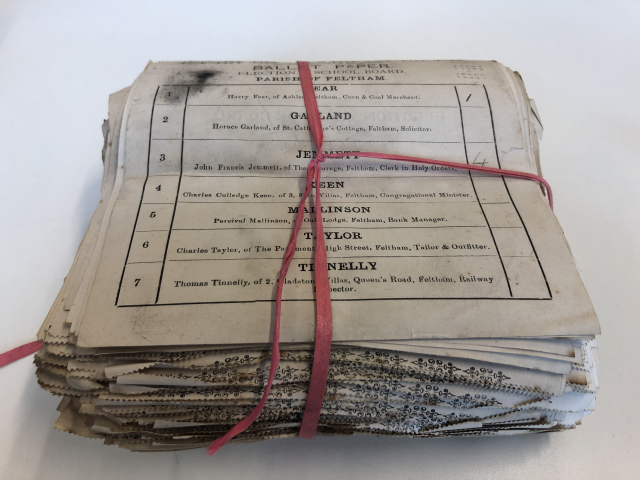
Among the collections at the London Archives is small stack of ballot papers, neatly tied together with a faded red ribbon. Visible on the top paper is a feature unfamiliar to most voters today: no ‘X’ next to the name of a preferred candidate, instead the numbers ‘1’ and ‘4’ against two candidates’ names. This apparent quirk points to the voting system used – the cumulative vote. Under this system, each individual voter had as many votes as there were people to be elected, and the freedom to distribute their votes in any way they wished, including ‘plumping’, giving all their votes to one candidate.
The ballot papers form a small part of a comprehensive set of materials relating to what turned out to be the final Feltham School Board election in 1901.1 The collection includes used and unused ballot papers, notices for polling staff and voters, pens, indelible pencils, the ballot paper perforating device, the marked register of voters, the counting book… In fact, it’s an entire returning officer’s kit, which even has printed notices for orientating voters to the: ‘Polling Station’, ‘The Way In’, and ‘The Way Out’.
These are rare surviving items from the 30-year period during which England and Wales elected school boards using the cumulative vote. My recent article explores the peculiarities of the electoral environment that grew out of these elections, shaped by the cumulative vote and its interplay with other innovations and reforms of the late nineteenth century. It argues that the cumulative vote at school board elections created an electoral environment that required strategic adjustment by candidates and emerging political parties, stimulating developments in organisation and campaigning that had important impacts on the broader political landscape.
Apart from the cumulative vote, the school board elections included the following novelties: any woman could stand for election; the secret ballot was trialled; as were extended or adjustable polling hours.
The research underpinning the article as part of my Queen Mary University of London PhD study, began with the gathering of data from school board elections from the British Newspaper Archive. Because no central record of school board election results was maintained at the time, individual results have remained hidden in the pages of local newspapers until digitization has made their retrieval possible. This resulted in a corpus of over 2,500 election results with associated information. The data has allowed for the exploration not only of the history of the school boards themselves, but also religious politics, the early election of women candidates, the emergence of socialist parties, research into party organisation, strategy, campaigning and more. It has also helped identify 128 MPs who were formerly members of English or Welsh school boards, in many cases decades before being elected to parliament. I intend to publish the accumulated English, Welsh, and Scottish school board election data in a repository on completion of the PhD.
The nuances of the electoral system used helped shape the school board elections into a testing ground: both from the perspective of the broader implementation of electoral systems and innovations; and from the perspective of individuals or groups participating, learning to organise and strategise to get elected to public office. As such, the school board elections served as live electoral experiments over a thirty-year-period, which saw the development of mass, organised, disciplined political parties contesting general elections. These innovations and initiatives came to have a lasting impact on the development of electoral processes in Britain.
References
1. The London Archives Collection ref. ACC/0809/FSB.