
Teaching History articles

Three years ago (TH 99, Curriculum Planning Edition), Michael Riley illustrated ways in which history departments could exploit the increased flexibility of the revised National Curriculum. He showed that precisely-worded enquiry questions, positioned thoughtfully across the Key Stage, help to ensure progression, challenge and coherence. His picturesque image for this...
Please note: this article pre-dates the 2014 National Curriculum and some content may be outdated. A great deal has been written recently about the importance of encouraging and enabling all students to read beyond their comfort zones, beyond the textbook and certainly beyond the obvious requirements of an examination specification....
Please note: this article pre-dates the 2014 National Curriculum and some content may be outdated. As an enthusiastic musician, Alison Meikle is always looking for ways to use music in the history classroom. While Teaching History has seen plenty of articles on using musical sources as evidence (e.g. Mastin in...
How can we plan for a coherent Year 7 that makes the most of the new National Curriculum freedom and its almost limitless possible content? Answer: borders, boundaries (and books) Please note: this article was published before the current 2014 National Curriculum.
Please note: this article pre-dates the 2014 National Curriculum and some content may be outdated. Conventionally, students learn to read before they come to secondary school. As a result, for the majority of our students, reading can be taken for granted. Yet sometimes, as history teachers, we can find that...
Everyone has seen a Roman emperor. Whether at the British Museum's current Hadrian exhibition, or in Derek Jacobi's stuttering Claudius, or in Joachim Phoenix's psychotic Commodus, most people are aware of Roman emperors to some extent or other.1 They can be semi-legendary, or have been entirely ignored by posterity. Some...
Please note: this article pre-dates the 2014 National Curriculum and some content may be outdated. When is a work of art a work of history? How can we get our students to appreciate the difference without ignoring the overlap? How should we ask our students to approach the historical film...
Please note: this article pre-dates the 2014 National Curriculum and some content may be outdated. Richard Harris and Terry Haydn recently carried out research funded by the Qualifications and Curriculum Authority into pupils' views and beliefs about history. Whilst the overall results were very encouraging (and more so than earlier,...
Please note: this article pre-dates the 2014 National Curriculum and some content may be outdated. Many of us would love to have the problems encountered by Oliver Knight at his previous school. His students were simply doing too well - leaving him wondering how to stretch them to the limit...
This issue's problem: Phyllis Wheatley already seems to be the most effective teacher in the department. How can her mentor ensure that she goes on learning? Phyllis Wheatley is several weeks into her second placement and her mentor, Selina, is acutely aware of how impressive her teaching is already. A...

Drawing upon a range of practice, Michael Riley analyses the characteristics of a good enquiry question. He explores the importance of careful wording of the question if it is genuinely to help the teacher to integrate areas of content into a purposeful learning journey and without distortion.He then moves on...
Please note: this article pre-dates the 2014 National Curriculum and some content may be outdated. In this article, Andrew Wrenn explores some issues that teachers might consider when supporting 14 and 15 year olds in their study of war memorials as historical interpretations. Tony McAleavy has argued that ‘popular' and...
Steve Illingworth argues that moral and intellectual development are not merely linked in the learning of history, but that moral development is a fitting goal for the study of history in its own right. He provides practical examples of ways of getting pupils to reflect on questions of right and...
Applicable to Britain 1066-1500, Britain 1500-1750, Britain 1750-1900, and many aspects of GCSE and AS/A2 courses. The version given in full here is for use in a study of Victorian Britain. This tackles the troublesome concept of relative status in a changing society. Exactly what is it that bestows status...
Please note: this article pre-dates the 2014 National Curriculum and some content may be outdated. Rosie Sheldrake and Dale Banham here share the results of their desire to use the curriculum changes which are upon us to do something which they had intended for some time. Their modern world study...
Please note: this article pre-dates the 2014 National Curriculum and some content may be outdated. The idea that subjects should abandon their ‘silos' and work together is bandied about currently a great deal - ‘subjects' and ‘silos' alliterate after all and so, of course, does the word ‘slogan'. What might...
Leisure time - like time itself - is fluid, and keeps changing its social meanings. From a ‘serious' high political perspective there is no history of leisure and leisure is trivial. Such perspectives have long lost their grip on the historical imagination, of course, and we have had histories of...
Please note: this article pre-dates the 2014 National Curriculum and some content may be outdated. Pupils in England have an entitlement to study history or geography until the age of sixteen. However, increasingly, some pupils seem to be discouraged from taking up this opportunity as it can be seen as...
Richard Baxter's mentor is struggling to know how to help him plan independently. Richard Baxter is a relatively young trainee with a background in ancient history. He came to the PGCE course straight after completing his undergraduate degree, and is aware of his relative youth as well as what he...
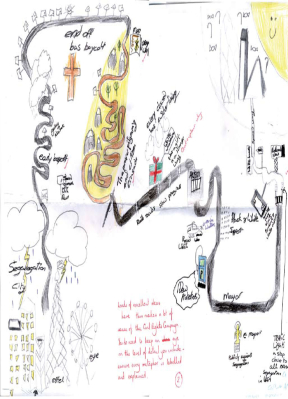
Please note: this article pre-dates the 2014 National Curriculum and some content may be outdated. Rachel Foster, a trainee teacher on teaching placement in November of her PGCE year, wanted her Year 9 pupils to understand the complexity of historical change. She also wanted them to find the difficult challenge...