
Teaching History articles
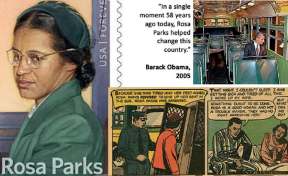
Inspired by Jeanne Theoharis’s biography of Rosa Parks, Ed Durbin initially planned to challenge the ‘fable’ that had been constructed around her life. He soon realised, however, that he wanted to take the opportunity to get ‘behind’ the fable and help his students understand how and why it had been...
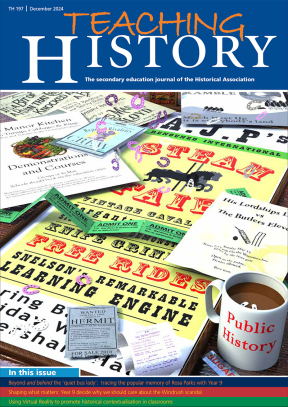
Read Teaching History 197: Public History Public history is history facing outwards: engaging with the public sphere beyond the ivory tower of research and scholarship in universities. In a recent essay entitled ‘Glorious memory’, Hicks writes of ‘an explosion of new public histories’ in recent decades, ‘led by communities from...

Move Me On is designed to build critical, informed debate about the character of teacher training, teacher education and professional development. It is also designed to offer practical help to all involved in training new history teachers. Each issue presents a situation in initial teacher education/training with an emphasis upon...
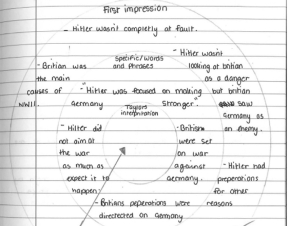
Following her PGCE year, Alex Blelloch became concerned about the ways in which some of the students she observed struggled to engage with the complexities of texts written by historians. More broadly, she was also concerned about the limited opportunities younger students had to engage with historians’ works. In this...
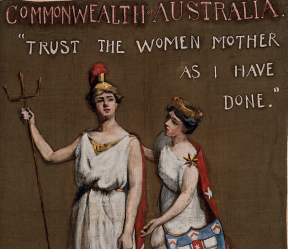
In this Cunning Plan, Jonathon Dallimore and Martin Douglas explore how teaching about the history of the suffrage movement in Australia can be used to raise questions both about the campaign for votes for women in Australia and wider questions about what defines Australian history. They also open up the...

As was the case for many heads of history, Jack Brown was prompted by the Black Lives Matter protests of 2020 to reflect afresh on the content and questions asked within his school’s history curriculum, paying particular attention to local history. In this article he sets out the principles and...
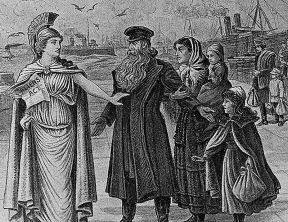
The Aliens Acts, passed between 1905 and 1925, marked a significant development in the history of controls on migrants in Britain. Analysing this legislation and the social realities of how it affected migrant communities allows students and educators to reveal insights into histories of migration. It has been suggested that...
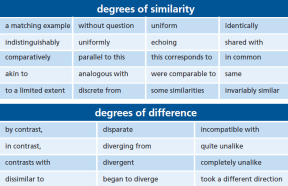
Reflecting on the quality of her pupils’ analyses of past diversity and complexity, Molly-Ann Navey was struck by the contrast with their writing geared to other types of disciplinary problem. Navey therefore set out to develop entirely new sequences of lessons which would teach pupils to shape arguments about similarity...
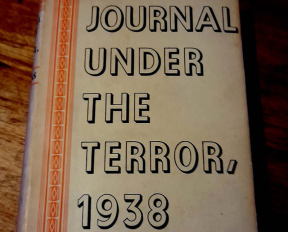
In April 2023, I attended an event at the University of Sheffield with my colleague, Katy Dixon, and a handful of our Year 10 historians. The event showcased the work of Professor Julie V. Gottlieb and playwright Nicola Baldwin who had written a play about the writer and critic of...

Ollie Barnes encountered Hong Kong history on honeymoon and, powerfully, in the classroom in Nottinghamshire. Historical changes in the former colony’s present had resulted in increasing numbers of Hong Kongers arriving in school. This history demanded attention – important historical changes were in process and pupils needed to understand them....
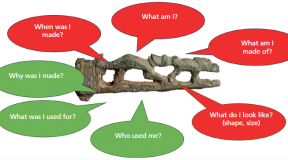
Maryam Dorudi arrived at her second PGCE placement school to find many pupils receiving free school meals and speaking English as an additional language. Wanting her students to identify as Londoners and historians, she was drawn into the world of mudlarking and Lara Maiklem. Over the course of eight lessons,...
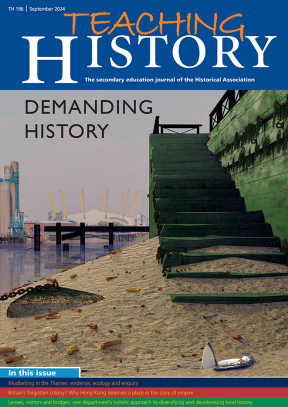
Read Teaching History 196: Demanding history History can be a very demanding subject, in a number of senses. The past can make demands on us – it can demand attention and demand to be addressed. There can, as it were, be historical as well as financial ‘final demands’, reminders of...
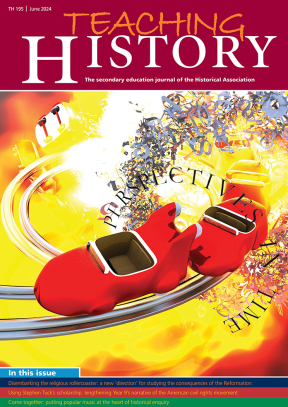
Read Teaching History 195: Perspectives in Time In the giant annual ‘card sort’ through which we editors shape numerous article proposals into themes, we found ourselves readily linking the pieces that now fall into this edition. There was a striking commonality; the theme was there. But what should we call...
Move Me On is designed to build critical, informed debate about the character of teacher training, teacher education and professional development. It is also designed to offer practical help to all involved in training new history teachers. Each issue presents a situation in initial teacher education/training with an emphasis upon...
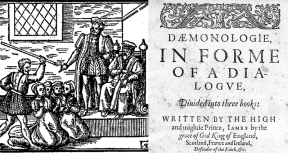
Maya Stiasny was troubled by a stubbornly persistent flaw in her A-level students’ conception of historical interpretations. Students were seeing historians’ arguments as snapshots in time, emerging magically and unproblematically out of personal views, rather than crafted as a process. Stiasny wanted her students to understand that process as an...
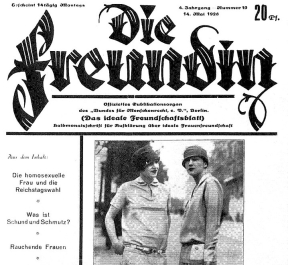
Berlin staged its first Christopher Street Day celebration in 1979. This queer pride event commemorated the Stonewall riots that took place a decade earlier in New York City, and it has continued to be a popular annual event in Germany. Its celebration of a landmark moment in American history, however,...

Drawing on a wide range of history teachers’ existing published work and presenting diverse examples of his own practice, David Ingledew builds a thorough curricular and pedagogic rationale for using popular music in history teaching. He shows how lyrics and music can be used as stimulus for various kinds of...
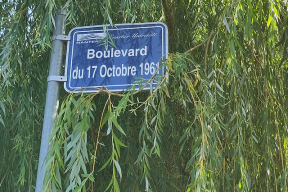
3 July 2024 marks the 50th anniversary of a significant, yet little known, event in French history: the declaration of an end to the recruitment of economic migrants. Over the previous decades, some three million migrant workers had arrived to surprisingly little fanfare, building the economic growth later mythologized by...
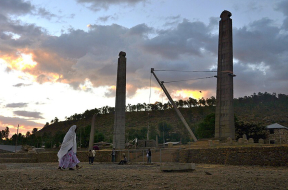
This Cunning Plan details an enquiry that I developed in order to achieve two curricular goals: to diversify our historical content and to help students to improve their disciplinary thinking and writing about similarity and difference. The enquiry addresses medieval Africa, specifically the East African kingdom of Aksum (approximately 300...
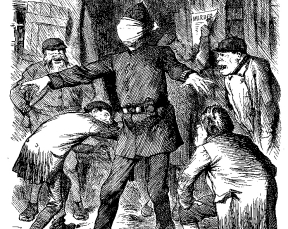
While history teachers (and examiners) regularly invite students to consider what cartoons or paintings reveal about contemporary attitudes to particular social or political developments, such sources are often difficult to interpret and to use appropriately. Drawing on a wealth of detailed research and a passion to support teachers and students...