
Teaching History articles

Maya Stiasny was faced with difficulties familiar to many of us. Her new Year 12 students were struggling to get to grips with a new period of history. They were not interrogating primary sources with sufficient vigour. Her solution, detailed here, was novel. Working on the rich social history of...
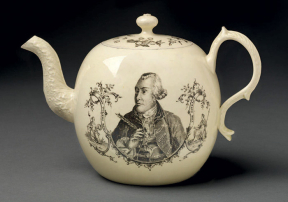
It seems that teapots really can talk. Eleanor Dimond took her undergraduate experience of studying material culture into the classroom, with startling results. Historians of material culture have developed distinctive evidential methods which, in stark contrast to typical GCSE and A-Level approaches, see a strong interplay between analysis of the...
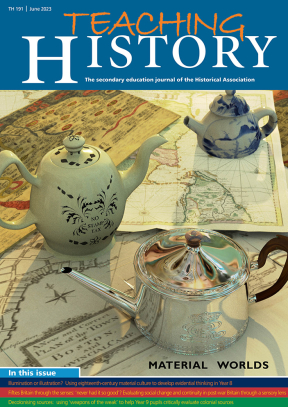
Read Teaching History 191 Please note: the print edition of Teaching History 191 will arrive with members in mid-July. Has the materiality of the past been neglected in secondary school history? Many history teachers might be surprised at the question. After all, enquiries featuring social, economic and cultural realities have...
Read Teaching History 190 As the collection of articles for this issue of Teaching History began to take shape, its title remained rather uncertain. While some of the articles referred explicitly to teaching historical significance, others focused more on teaching students the processes involved in shaping stories about the past....

Move Me On is designed to build critical, informed debate about the character of teacher training, teacher education and professional development. It is also designed to offer practical help to all involved in training new history teachers. Each issue presents a situation in initial teacher education/training with an emphasis upon...
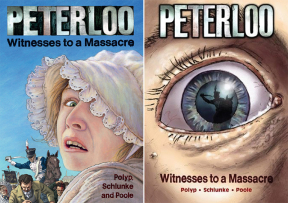
While previous work on historical interpretations has focused students’ attention on the particular questions that historians have been asking or the context in which they have been posing those questions, less attention has been paid to the process of historical narration itself – the decisions that are made in telling...
The British industrial revolution stands out as a pivotal moment in human history. Its timing, causes and consequences have all been major topics of historical enquiry for well over one hundred years. Many of the great Victorian commentators – Engels, Dickens, Blake to name a few – who lived through...
In principle, Rachel Foster had long been aware of the value of creating an interplay between depth and overview across the history curriculum. But in practice, as she acknowledges here, she had tended to shy away from telling outline stories that encompassed a big chronological or geographical range. Recognising the...

Offered five weeks to teach ‘whatever he wanted’ to Year 7, Andrew Slater decided that he wished to tackle the concept of significance head-on early in his students’ time in his school. He chose the expectedly unfamiliar substantive content of the Khmer Empire, challenging his students to justify the significance...
Many pupils love the Horrible Histories books, television programmes and songs. Over the years a number of A-level pupils have proudly told me that it was Horrible Histories that sparked their love of the subject, and they are quick to recite the songs word for word! But it is also...
Jane Card’s previous work on the power of images in conveying particular interpretations and her advice about how to use visual material effectively in classrooms will be familiar to readers of Teaching History. In this article she focuses specifically on the capacity of visual representations to convey a compelling message...
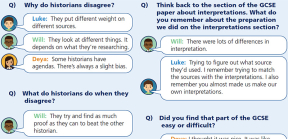
Shortly before their final A-level examination, Peter Turner was alarmed to discover some fundamental weaknesses in his Year 13 students’ understanding of the nature of historical interpretations. Determined to address this concern at a much earlier point with his next cohort of students he developed a new six-lesson enquiry. His...
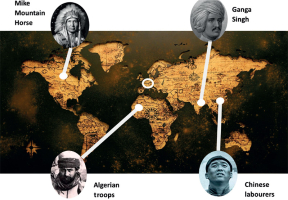
When Paula Worth met with history-teaching colleagues to explore how they could improve their teaching about historical significance, she found that she was far from alone in finding the process a daunting one. Prompted to investigate the difficulties she had encountered, Worth realised that that she had previously reached for...
Read Teaching History 189: Collaboration Teaching requires many kinds of knowledge, which has many different sources. One of those sources of knowledge is other professionals. But history teachers are not simply passive receivers of settled bodies of knowledge produced by others. As the pages of Teaching History attest, there is...
Move Me On is designed to build critical, informed debate about the character of teacher training, teacher education and professional development. It is also designed to offer practical help to all involved in training new history teachers. Each issue presents a situation in initial teacher education/training with an emphasis upon...
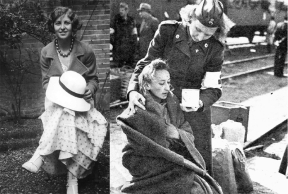
Responding to concerns about Dutch students’ citizenship education, Tim Huijgen, Paul Holthuis, Roel Nijmeijer and Iris van den Brand set out to design online materials to help students understand the decisions and dilemmas faced by past actors. They focused on the life and actions of Rosie Glaser (1914–2000), a Dutch...
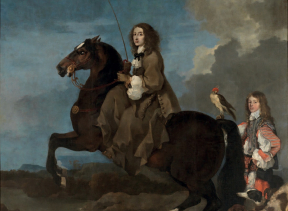
‘Royal Studies’ is much more than the study of kings and queens as individuals. It draws in their families, the institution of monarchy and monarchical government, court studies, relationships with the church, artistic and literary patronage, and more. While history ‘from below’ and studies of non-elite figures have enriched the...
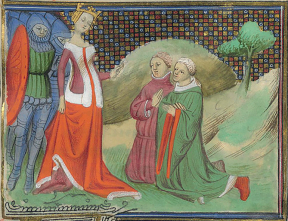
Sarah Longair launched a collaborative project between school history teachers and university historians in the midst of the Covid-19 pandemic. In this article, Longair and her teacher colleagues, Kerry Milligan and Emma McKenna, share how they used online collaboration to develop a flexible and practical approach to school–university collaboration, and...
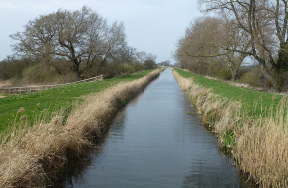
Confined to his home during lockdown in 2020, teacher Josh Mellor became eager to explore the history of the physical environment on his doorstep. After reading about different approaches to using environmental history in the classroom, Mellor decided to design an enquiry to explore the changing landscape of the Fens...
When Will Bailey-Watson (a history ITE tutor) and Charlie Crouch (a history PhD student) worked together to improve a history undergraduate course at their university, they realised that the benefits of collaboration between teachers and historians can flow both ways. In this article they offer an account of how they...