Planning

This section organises material on Key Stage 3 planning into three categories. In KS3 planning: general, you will find general advice on planning in the lower secondary years. This includes examples of how history teachers and other history education experts have planned everything from single activities and lessons to two or three years of work.  You will find examples of planning for local history in KS3 planning: local history.  The third category, KS3 planning: Learning outside the classroom embraces fieldwork of all kinds, from studying landscape and cities, to museums, galleries and memorials, as well as inter-school activities, work with outside organisations and assorted international collaborations, real and virtual. Read more

Sort by: Date (Newest first) | Title A-Z
Show: All | Articles | Podcasts | Multipage Articles
  • Historical reasoning in the classroom

    Article

    Historical reasoning in the classroom: What does it look like and how can we enhance it? The history education community has long recognised that historical thinking depends on the interplay between substantive knowledge about the past and the procedural, or second-order, concepts that historians use to construct, shape and give...

    Click to view
  • Move Me On 149: how to provide appropriate support for particular students

    Article

    This issue's problem: Helen Troy is uncertain how to provide appropriate support for certain students without restricting what they can achieve. Helen showed considerable determination in securing her teacher training place. Her own education had been within a highly selective school system and her first application was unsuccessful because of...

    Click to view
  • Designing an enquiry in a challenging setting

    Article

    The Association for Historical Dialogue and Research (AHDR) is a Cyprus-based organization that works to foster dialogue among history teachers and other educators across the divide in Cyprus. In one of their UN-funded projects, ADHR members worked with UK colleagues to shape a lesson sequence and resources on the Ottoman period...

    Click to view
  • Cunning Plan 149.1: a Year 7 lesson on Gladiators

    Article

    This seemingly straightforward question will prompt correspondingly straightforward answers from your mixed-ability Year 7 class, such as ‘they were slaves who fought with swords until one of the men died for the crowd's entertainment', as one of my pupils answered. Scratch the surface, and almost every word in this response...

    Click to view
  • Helping Year 7 put some flesh on Roman bones

    Article

    Like many other history departments nationally, Ed Podesta and his colleagues face a daunting practical challenge: redesigning three years' historical learning so that it can fit into a compressed two-year Key Stage 3, whilst enhancing, rather than compromising, the quality of students' historical learning. Podesta's article reports the beginning of...

    Click to view
  • Where are we? The place of women in history curricula

    Article

    Joanne Pearson reflects on her experiences as a history teacher and teacher educator, considering the ways in which she has seen women represented in the history curricula of different schools in England. She makes the case that greater attention needs to be paid by history teachers to the criteria against...

    Click to view
  • Teaching History 147: Curriculum Architecture

    Article

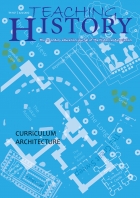
    02 Editorial  03 HA Secondary News  04 HA Update  08 Beth Baker and Steven Mastin - Did Alexander really ask, ‘Do I appear to you to be a bastard?' Using ancient texts to improve pupils' critical thinking (Read article) 14 Cunning Plan: Getting students to use classical texts - Beth Baker...

    Click to view
  • Developing Year 8 students' conceptual thinking about diversity in Victorian society

    Article

    Developing Year 8 students' conceptual thinking about diversity in Victorian society Elizabeth Carr writes here about a new scheme of work she developed to teach students about diversity in Victorian society. When dealing with a concept such as diversity, it can be easy for students to slip into stereotypes based...

    Click to view
  • Triumphs Show 146: putting an enquiry together

    Article

    Department meetings have a range of purposes, and all teachers will be aware of some of the more tedious tasks that have to be completed at such meetings. The most exciting meetings for us are those where we can sit down as a history department and design a new enquiry....

    Click to view
  • 'Doing justice to history': the learning of African history in a North London secondary school

    Article

    ‘Doing justice to history': the learning of African history in a North London secondary school and teacher development in the spirit of ubuntu The medium is the message, Marshall McLuhan observed many years ago and the ‘form' of what we do carries ‘content' as Hayden White has argued. This article...

    Click to view
  • Key Concepts at Key Stage 3

    Multipage Article

    Please note: This unit was produced before the 2014 National Curriculum and therefore while much of the advice is still useful, there may be some out of date references or links. For more recent resources on key concepts, see our What's the Wisdom on series. The key concepts can be divided into three...

    Click to view
  • Cunning Plan 144: promoting independent student enquiry

    Article

    Getting students to generate their own questions can seem like a formidable challenge, even for experienced teachers with extensive subject knowledge developed over years of teaching. Imagine how much more alarming it appeared to a student-teacher being encouraged to take risks by handing more responsibility to the students. Could it...

    Click to view
  • Using ‘Assessment for Learning' to help students assume responsibility

    Article

    Robin Conway's interest in student led enquiry derived from a concern to encourage his students to take much more responsibility for their own learning. Here he explains how his department gradually learned to entrust students with defining the enquiry questions and planning the kinds of teaching and learning activities to be...

    Click to view
  • Pupil-led historical enquiry: what might this actually be?

    Article

    The current National Curriculum for history requires pupils to ‘identify and investigate specific historical questions, making and testing hypotheses for themselves'. While Kate Hammond relished the encouragement that this gave to her pupils to engage in the process of historical enquiry, she was keen to develop a much clearer sense...

    Click to view
  • Understanding 'change and continuity' through colours and timelines

    Article

    The small-scale research that Yosanne Vella reports in this article was driven by concern to help pupils develop ‘big picture' visions of the past and to engage effectively with the idea of change as a process rather than an event. The strategy that she adopts - asking groups of students...

    Click to view
  • Getting Year 7 to vocalise responses to the murder of Thomas Becket

    Article

    Mary Partridge wanted her pupils not only to become more aware of competing and contrasting voices in the past, but to understand  how historians orchestrate those voices. Using Edward Grim's eye-witness account of Thomas Becket's murder, her Year 7 pupils explored nuances in the word ‘shocking' as a way of...

    Click to view
  • Seeing the historical world

    Article

    In this article, Lindsay Cassedy, Catherine Flaherty and Michael Fordham draw upon their empirical research to assess what understandings their students had of historical interpretations at the end of their compulsory education in history. They found that most students operated with an underlying epistemological model that did not reflect the...

    Click to view
  • Polychronicon 142: 'instructive reversals' - (re)interpreting the 1857 events in Northern India

    Article

    The dramatic, chaotic and violent events that took place in Northern India in 1857/8 have been interpreted in many ways, as, for example, the ‘Indian Mutiny', the ‘Sepoy War' and the ‘First Indian War of Independence'. The tales that have been told about these events have been profoundly shaped, however,...

    Click to view
  • Cunning Plan 142: Why do historical interpretations change over time?

    Article

    History teachers have been talking about the need to teach broad narratives, overview and chronology for a long time. They have also recognised how essential it is for students to have an opportunity to study the ways in which the past has been interpreted, and the reasons why these interpretations...

    Click to view
  • Bob Dylan and the concept of evidence

    Article

    No edition of Teaching History devoted to creativity could be complete without returning to the riches that popular songs offer to historians and history teachers alike. The five Bob Dylan songs that Christopher Edwards explores here are chosen not merely for their ‘literary qualities' and ‘emotional charge'; they also provide...

    Click to view