
Historian articles

The 1630s in England began effectively in 1629 with the abrupt dismissal of Charles I’s third parliament and ended in 1640 at the first meeting of what would become the Long Parliament. Similarly we may start the 1650s with the regicide of January 1649 and finish with the surprising return...
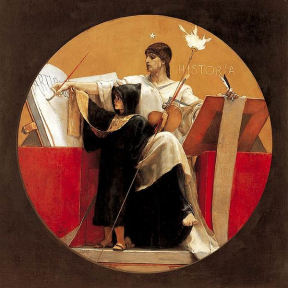
Professor Eric Hobsbawm’s address at the Annual Dinner of the Historical Association meeting in Cambridge, April 1999, on accepting the Medlicott Medal. Our annual award the Medlicott Medal is awarded to individuals for outstanding services and current contributions to history.
This paper was delivered at the British Library on 30th January 1999 at a joint meeting to commemerate the 350th anniversary of the execution of Charles I.
In the 1980s it was often argued that the Labour party was finished as a major force in British politics. Yet on 1st May 1997 it won a landslide victory, securing an overall majority of 179 in parliament. Two years into its term of office, it retains a strong lead...
Historians view major anniversaries with a measure of ambivalence. We know that they are artificial, that it is merely a convenient fiction to think that the passage of a round number of years provides a privileged vantage point from which to review the significance of a given event. Yet we...
The pamphlet printing industry in England received an unexpected boost in 1871 with the appearance of numerous works written, mainly, as commentaries, satires or allegories in Britain’s attitude regarding the Franco-Prussian War. The cause of this deluge was one particular tract, first issued on Salisbury in October 1870, whose purpose...
Carl Watts outlines the shift in British security policy and examines the role played by the Foreign Office during the post-War period. April 1999 marks the 50th anniversary of the signature of the North Atlantic Treaty, which came into effect in August 1949. The Cold War is over, but NATO...
In December 1687 Sir William Petty, a founder member, attended the annual dinner of the Royal Society. He was obviously seriously ill and in 'greate pain' and shortly afterwards, on December 16th, he died in his house in Piccadilly, opposite St James Church. It was a quiet end to a...
Emeritus Professor G. R. Batho a personal perspective on the city of the prince bishops. We all have highly personal impressions of the towns and cities with which we are familiar. Few readers of The Historian are likely to emulate the good lady who hearing that I was leaving the...
R. J. Knecht suggests that the 'Black Legend' may not be quite as unfair to Catherine as her defenders have argued. Few historical figures have aroused as much passionate controversy as Catherine de’ Medici who was queen of France from 1547 until 1559 and several times regent before her death...
Dr Julian Jackson examines the position and treatment of Jews in Occupied France. When in 1945 France came to try those who had ‘collaborated’ during the war, the fate of the Jews was not central. It was even possible for Xavier Vallat, Vichy’s Commissioner for Jewish Affairs, to defend himself...
Dr Jacqueline Beaumont Hughes considers some aspects of the role of the Press during the Boer War. The conflict between Great Britain and the Republics of the Transvaal and Orange Free State which slipped into war in October 1899 was to become the most significant since the Crimean war. It...
Elisabeth Leedham-Green reflects on reality in the famous university town of Cambridge. This is a sharp place, best encountered when, as surprisingly often, the sun is shining and there is frost in the air. Then the stone sparkles and seems to float a few inches above the gleaming grass —...
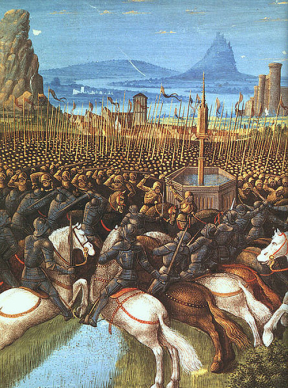
Professor Malcolm Barber explores the rise and fall of the Knights Templars. "The master of the Temple was a good knight and stout-hearted, but he mistreated all other people as he was too overweening. He would not place any credence in the advice of the master of the Hospital, Brother...
Malcolm Crook examines the remarkable ascent to power of Napoleon at the turn of the nineteenth century. The great Bicentenary of the French Revolution of 1789 may be drawing to a close, but that of Napoleon is about to commence. So now is an opportune moment to present a critical...
Dr Michael Bush investigates the interpretations of the pilgrimage of grace. Our perception of the pilgrimage of grace has been largely created by Madeleine and Ruth Dodds and their magnificent book The Pilgrimage of Grace, 1536-7, and the Exeter Conspiracy, 1538 (Cambridge). Published in 1915, it has dominated the subject...
Dr John Shepherd reviews the history of a major anthropological expedition one hundred years ago. On 10 March 1898 The Times reported that Cambridge Anthropological Expedition led by Alfred Cort Haddon had sailed from London, bound for the Torres Strait region between Australia and New Guinea. In Imperial Britain, the...
Judith M. Brown spoke on Nehru as her subject for the 1998 Cust lecture at the University of Nottingham. Her portrait of this major Indian statesman is published here for the first time.
Pam Sharpe reflects on the journals and expeditions of a 17th-century traveller. I first encountered Celia Fiennes (1662-1741), early modern traveller and journal writer, when I was an undergraduate. Being a keen traveller myself and studying social and economic history, Fiennes’ journeys fascinated me1. Here was a woman who travelled...
John Major discusses an astonishing aspect of past Anglo-American history. All great powers have developed contingency plans for war with each other, and the United States in the early twentieth century was no exception. Each of Washington’s schemes was given a distinctive colour. Green mapped out intervention in neighbouring Mexico,...