

Teaching History 203: Out now
The HA's journal for secondary history teachers
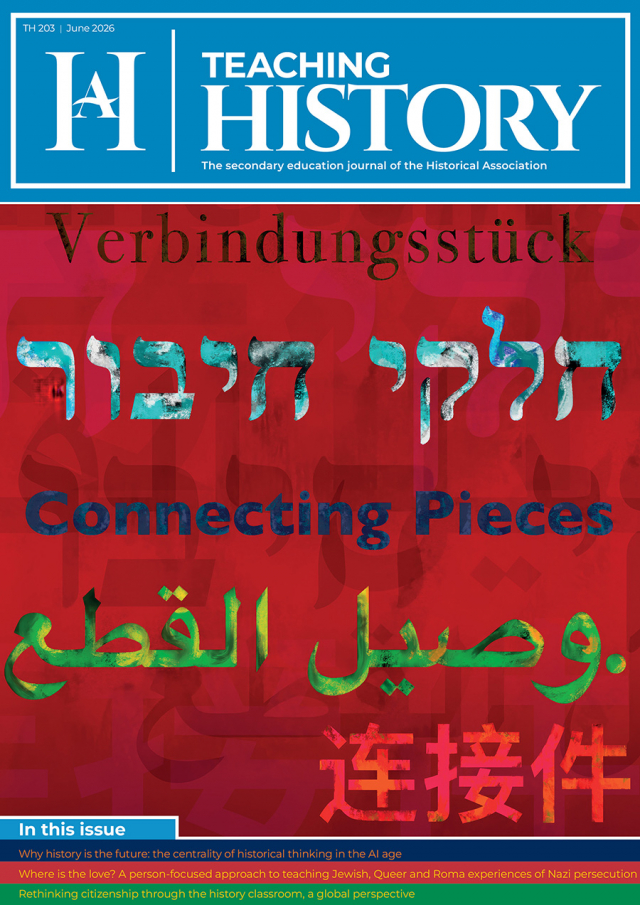
Editorial: Connecting Pieces
Read Teaching History 203: Connecting Pieces
One of the immense privileges of editing Teaching History is the joy of learning so much from our authors’ work. We learn history we did not know. We learn from engaging deeply with history teachers’ projects – especially those of new authors – to help them prepare their work for publication. We learn from seeing history teachers’ creativity and collaborations join up into new collective knowledge for the profession.
This edition has been a highlight, and the joys began, as they often do, with trying to work out what on earth to call the theme that links them together! At first, when we grouped these authors’ proposals into an edition, we felt that it was something to do with representative history. Several authors were wanting their students to notice, to take seriously and to integrate, stories and voices that have often seemed invisible or been downplayed in the past.
Yet while this is certainly true of many of the articles – the focus on the role of Muslim rescuers in the Holocaust, on disability in history, on Jewish, Roma and Queer experiences in Weimar – we felt something else coming through. What was it? It was not just that these might be hitherto missing pieces, it was rather their role in connecting things together – connecting groups and phenomena in the past, and connecting disparate aspects of the past for students. These were ‘connecting pieces’. And some authors were writing explicitly about that in itself – history’s way of helping students make connection.
Kieran Lavis and Katharine Burn begin with an extremely important piece for our times – the bewildering speed of development and far-reaching implications of AI. Theirs is a crucial analysis: history itself has distinctive and vital contributions to make to the most serious challenges that AI presents to education: teaching students to evaluate AI-generated content critically and helping them understand that all that AI produces is the result of human decisions. Their article is a rallying cry to avoid the dangerous slide into a generic conception of critical thinking which is once again raising its head.
Many readers will have attended Rob Kanter’s session on stories of Muslim rescue in the Holocaust at the recent Historical Association conference and will be excited to see the fruits of his scholarship written up here. Kanter shares his research on Jewish-Muslim relations over time, both in the past and in work of subsequent interpretation. His piece connects with many articles in Teaching History on Islamic history, supplying both further historical context, a wide historiographical lens and examples of case studies which can be integrated into school curricula.
Jacob Thorpe builds on earlier articles n teaching about diverse experiences during Weimar, but his is a fresh lens. His major focus was student engagement, and here he builds his framework for a fuller understanding of ‘personhood’ to be at the heart of student study. This has similarities with the work of Alex Fairlamb who gives an honest account of her own journey of self-evaluation as she sought to make the presence of disability in history much more salient, but also much better integrated. Fairlamb shows her journey of attending to historical scholarship about disability in the past, and offers challenges for teachers to think differently about how integration happens.
Oliver Scott widens the lens dramatically. The idea of connection is right at the heart of his piece. In an ambitious project, he sought to build on much recent work on using narrative in the classroom, but this time by having pupils write their own really vast narratives which would pull the curriculum together. He uses a wide range of published history teacher practice on narrative, starting with a challenge made by Lang over 20 years ago.1 Inspiration was the history writing for children of E.H. Gombrich. Joshua Bull likewise widens the lens but chooses to do so conceptually. In our Triumphs Show for this edition, Bull builds on earlier work on teaching pupils to analyse consequences, especially the work of Navey in Teaching History, 172.2 He builds a delightfully punning model involving the three Ds of depth, distance and duration.
Finally, Andrew Carey also thinks big about connections, and this time on spatial and temporal scales. He reaches back into work done on the relationship between history and citizenship carried out in England, both in policy and in practice, nearly 30 years ago. He mines it for insights relevant to today and relevant to his international context. He then reverses the flow of influence and suggests how a focus on global citizenship could enhance England’s traditions of teaching citizenship.
This edition ranges widely across scales of planning, wide temporal scales in history education practice, always drawing on and renewing prior collective knowledge of the profession, across historical time and across dimensions of human life. Each author shows the critical importance of connections which help students to make meaning, to render history memorable and to show its burning relevance for the challenges of their time.
References
1. Lang, S. (2003) ‘Narrative: the under-rated skill’ in Teaching History, 110, Communication Edition, pp. 8–13.
2. Navey, M. (2018) ‘Dealing with the consequences: what do we want students to do with consequence in history?’ in Teaching History, 172, Cause and Consequence Edition, p. 42.