

Year of Reading: themes for July
US Independence and American literature
As we continue into the National Year of Reading, July offers many historical anniversaries to explore through literature – starting with the 250th anniversary of the American Declaration of Independence, adopted in 1776 on 4 July: ‘Independence Day’.
Our upcoming American Culture webinar series (30 June–8 Sept) focuses on literature and storytelling, including the experience of Black writers in the segregated South; the rise of hardboiled crime fiction with writers like Raymond Chandler (who happens to have a July birthday, 23 July 1888); and Phillis Wheatley Peters, the first Black poet to publish a book of poems in English. You can still book your place for the webinar series here.
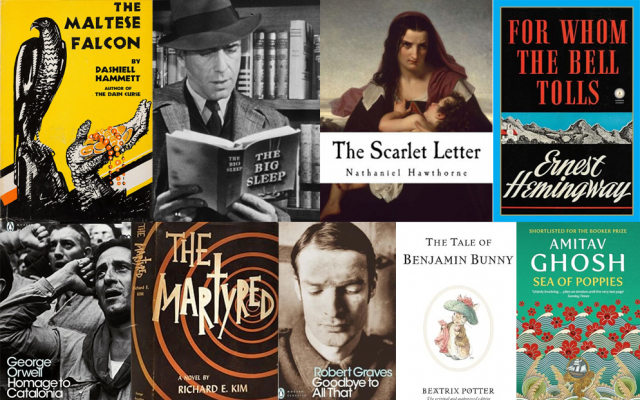
American author Nathaniel Hawthorne was also auspiciously born on Independence Day in 1804. He became famous for darkly moral ‘American Gothic’ tales such as The Scarlet Letter (1850) and The House of the Seven Gables (1851), with a focus on Puritan guilt and hypocrisy, hidden sins and family curses, and the lurking fears of madness and hell. Other classic American Gothic authors include Edgar Allan Poe, Charles Brockden Brown and Washington Irving. Find out more here (open access)
Hemingway and the Spanish Civil War
Another American writer with a July birthday is Ernest Hemingway (21 July 1899), renowned for his economical writing style, outspoken persona and romantic life. As a correspondent for the North American Newspaper Alliance he covered the Spanish Civil War (which began on 17 July 1936, so this July is the 90th anniversary). His eyewitness reporting of the conflict ultimately led to his celebrated 1940 novel For Whom the Bell Tolls.
Also born in July (1894), Brave New World author Aldous Huxley took a pacifist stance in the Spanish Civil War and put his efforts into humanitarian relief (unlike George Orwell, whose Homage to Catalonia recounts his experiences of fighting in the conflict). Huxley also wrote the prologue for And They Still Draw Pictures! (1938), featuring drawings by refugee children affected by the Spanish Civil War.
More July conflicts
And July has plenty more wars and uprisings that have left their mark in historical literature. 1 July is the 110th anniversary of the start of WW1’s Battle of the Somme in 1916. Novels inspired by the infamous battle include Sebastian Faulks’ Birdsong and Robert Graves’ Good-bye to All That; or for first-hand accounts there’s the unflinching war poetry of Siegfried Sassoon and Wilfred Owens.
- Listen to our podcast on First World War Poetry
- Read our student guide on First World War literature (open access)
More recently, 27 July marks the end of the Korean War in 1953. Novels about the conflict include The Martyred by Richard E. Kim and MASH: A Novel About Three Army Doctors by Richard Hooker (on which the 1970s TV sitcom was based).
And 14 July is of course Bastille Day, commemorating the 1789 ‘storming of the Bastille’ by citizens of Paris, traditionally considered the start of the French Revolution. Three Musketeers author Alexandre Dumas (another July birthday, in 1802) fictionalised the events in his novel Taking the Bastile.
Beatrix Potter
Less bloodily, July 2026 marks Beatrix Potter’s 160th birthday (born 28 July 1866). She’s best known of course for her classic illustrated children’s books featuring animal characters like The Tale of Squirrel Nutkin and Peter Rabbit, but she was also a natural scientist and conservationist. Our 2016 Primary History article compares Beatrix Potter and Benjamin Zephaniah
South Asian heritage
July is also South Asian Heritage Month. Why not celebrate it by reading a novel by Salman Rushdie, Arundhati Roy, Monica Ali, Vikram Seth, Kamila Shamsie, or historian and author Amitav Ghosh?
So whatever you’re commemorating this July, make sure you have plenty of good historical books to help you!