

The Girl Who Raced the World
By Nat Harrison
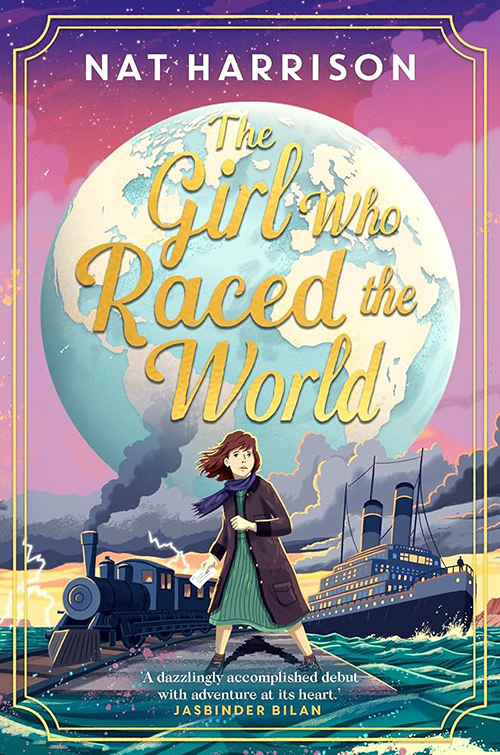
Review by Elsie, Age 13, Lagan College Belfast
I really enjoyed reading “The Girl who Raced the World” as I have never read the original “Around the World in Eighty Days” and this encouraged me to read the original novel. I loved how it was based off the original, but it had a twist that is still believable in that time period even though it feels more modern and relatable.
It has plenty of factual and historical content, and the story weaves throughout the different customs at that time in all the different places the characters visit during their journey. The characters in the story travel to many different places, and the book has inspired me to read other books about life in the circus, the jungle, and on passenger ships during 1872. I found the different types of travel (e.g. boat, snow-sledge, train) interesting and I learnt a lot about the different customs and traditions in the 19th century.
I think my favourite character was Mr. Phileas Fogg as he was mysterious and unpredictable. For example, Maggie (the main character) describes him as stony-faced, yet later he gives a handful of money to a poor woman so she can buy medicine for her child. I would describe the plot as exciting and mysterious with plenty of twists and would definitely recommend it to others. I liked all the characters, but I think Passepartout’s character was too simple, and he never really interested me. Although I think his character could be more exciting, it suited the story line and his personality perfectly.
I think what stands out most to me is the difference between first and second class, and how different 1872 is compared to the 21st century. One of the main characters (Passepartout) was French and many French phrases were incorporated into the book. A sailor from New Zealand also told Maggie that love is “aroha” in his language and there were plenty of songs in other languages that were hidden throughout the book. I also learnt that a ‘thotti’ was a stick with a sharp point that was used to train elephants in the jungle. Overall, I think it was a very good read, although occasionally it would contradict itself and became a bit confusing as it would jump over some days, and the date wasn’t always clear. Apart from that, I think the book is amazing and it made me want to travel around the world!
Review by Matilda, Year 8, Ashcroft Technology Academy
This book was set in the 19th century, and it is an adaptation of Around The World In 80 Days. The main character is a young orphan girl called Maggie, who is struggling to survive since her mother died. She is taken up by Phileas Fogg and his valet, Passepartout, and together they attempt to go around the world in just 80 days! Personally, I thought that the fact that it was set in the 19th century was clever as that was a time of vast industrial development. This meant that many of the countries they travelled to were busy, exciting and there were always many ships and trains when they arrived in a new place. This really added to the sense of excitement and adventure that could be felt throughout the book.
I really liked Maggie, the orphan girl, as she was funny, kind and relatable for the readers that this book was aimed at (children aged 8-11). However, I would have liked it if the book went into more depth about her and her mother’s backstory, as many things were left unclear. But overall, her relatability makes the reader feel like they are on the journey with her as they can clearly understand and sympathise with her feelings. Her circumstances taught me that life was very different for children in the 19th century, and many adults would have been unsympathetic and harsh to poor children like her. For example, she is sent to the workhouse once her mother dies, and is forced to work in horrible conditions until she escapes. Today, that situation would be unacceptable, so it demonstrates how society has changed for the better in that respect.
The thing that most stood out for me from the book was the way that the author showed many different countries with different atmospheres and cultures. This made me really appreciate how important it is to learn about other countries. The magic of travelling to new places was really emphasised through Maggie, as she has never travelled before and the experience is presented as eye-opening to her.
I didn’t like how the plot moved very quickly as I found it confusing and hard to keep track of. The storyline often had a lot of action happening in just a few pages, which was often overwhelming and left me feeling unsure on what was going on. For example, the characters would change location very quickly, which didn’t always make sense straight away. However, on the whole, I would definitely recommend this book to other pupils. I would suggest that they read Around The World In 80 Days (The Girl Who Raced The World is an adaptation of this) first as the storyline would most likely be easier to follow and make more sense. It’s a really enjoyable, fun read that has a perfect balance of mystery, adventure, emotion and excitement.