
Progression & Assessment
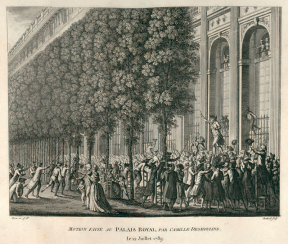
Recognising a significant return to stories in the history classroom, Holliss and Carroll wanted to think carefully about what this meant for A-level history. While stories had always been present in their classrooms, they wanted to experiment with the methods of the ‘new storytellers’, building lessons, then sequences of lessons,...
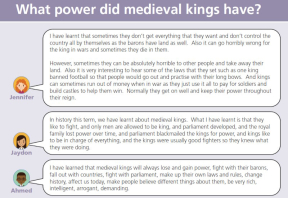
Christine Counsell sets out her concerns about the effects on history teaching of recent trends in secondary assessment practice. Situating her analysis within a long-term story of interplay between government policy, classroom practice and school leadership responses to inspection, Counsell sees new distortions emerging in the name of knowledge. She...
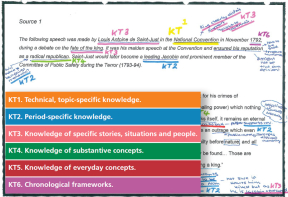
Frustrated by the generic statements that her Year 12 students were making about sources, Jacqueline Vyrnwy-Pierce resolved to undertake a research project into how her students were approaching sources about the French Revolution. Fascinated by the research of American educational psychologist Sam Wineburg, Vyrnwy-Pierce decided to use Wineburg’s methods to...

Students of A-level history are required to analyse and evaluate historical interpretations. Samuel Head found limitations in his Year 13 students’ understanding of how and why historians arrive at differing interpretations, which impeded their ability to analyse them. He set about tackling this with carefully sequenced planning and a processual...
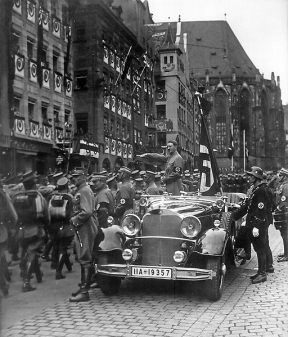
Jim Carroll relished the opportunity, in the new A-level specification he was teaching, to find an effective way of teaching his students to analyse interpretations in their coursework essays. Reflecting on the difficulties he had faced as a trainee teacher teaching younger pupils about interpretations, and dissatisfied with examination board...
Jim Carroll was concerned that A-level textbooks failed to provide his students with a model of the multi-voicedness that characterises written history. In order to show his students that historians constantly engage in argument as they write, Carroll turned to academic scholarship for models of multi-voiced history. Carroll explains here...

An exploration of the impact of university preparation classes on sixth-form historians Frustrated by the low numbers of students from her comprehensive state school who expressed any interest in applying to Oxford or Cambridge to study history, Lucy Hemsley set out to explore ways in which she might both inspire...
In her introduction to this piece, Carolyn Massey describes history teachers as professionals who pride themselves on ‘a sophisticated understanding of change and continuity’. How often, though, do we bemoan change when it comes, as it so often has recently? Massey’s article provides an example of how to embrace change,...
Jim Carroll noticed basic literacy errors in his Year 13s’ writing, but on closer examination decided that these were not best addressed purely as literacy issues. Through an intervention based on clauses, Carroll managed to enable his students to write better, but he did this by teasing out principles of...

Alex Alcoe was concerned that mastery of certain keywords and question formulae at GCSE perhaps obscured fundamental gaps in his students’ understanding of the nature of causation. These gaps were revealed when he invited Year 12 students to make explicit, by annotating a diagram, their understanding of the relationship between...

While preparing her Year 12 students for an International Baccalaureate paper on early Islam, Kirstie Murray became concerned that students' weaknesses in making claims would be particularly exposed by the challenging complexity of this topic's source record and its contested historiography. Drawing on the practice of other history teachers, especially...
Long, unreadable sentences in her students' essays led Rachel Foster to improve her post-16 students' punctuation. Her journey resulted, however, in more than improved punctuation. It led her to theorise what historians are really doing in their ‘signpost sentences'. She found herself showing students how an academic historian anticipates a...
Hark the herald tables sing! Achieving higher-order thinking with a chorus of sixth-form pupils On 9 April 1930, a philanthropist called Edward Harkness donated millions of dollars to the Phillips Exeter Academy in the USA. He hoped that his donation could be used to find a new way for students...

This issue's problem: Fred North treats ‘Assessment for Learning' as though it is a bolt-on extra unconnected to his learning objectives Fred is an enthusiastic trainee who has generally made a good impression on students and colleagues over the course of his first term. He has been determined to establish...
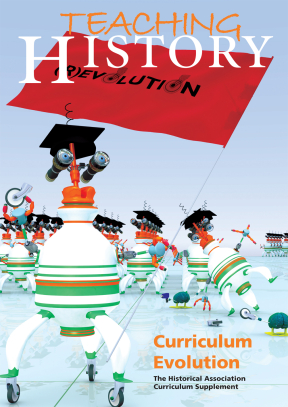
Although modifications to the content of the National Curriculum for history have not been as dramatic as once feared, the effective revocation of the previous attainment target is radical indeed. When these changes are considered alongside the fact that more than half of maintained secondary schools (all academies and free...
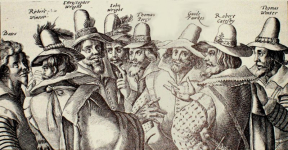
Moving forwards while looking back: historical consciousness in sixth-form students A key concern driving debates about curriculum reform in England is anxiety that young people's knowledge of the past is too episodic - that they lack a coherent ‘narrative' or ‘map' of the past. While recent debate focused on what...

'New, Novice or Nervous?' is for those new to the published writings of history teachers. Every problem you wrestle with, other teachers have wrestled with too. Quick fixes don't exist. But if you discover others' writing, you'll soon find - and want to join - something better: an international conversation...

Drawing on her research into students' evidential reasoning, Elisabeth Pickles explores the possibilities for how such reasoning might be assessed. Existing exam mark schemes focus too heavily on generic processes involved in the analysis of source material and insufficiently on the historical validity of reasoning and conclusions produced. Approaching the...
Richard Harris challenges those who play down the essay in their teaching of the new AS Level. He argues that essay-writing embodies historical thinking and that it is therefore an essential tool for developing students’ understanding of history as an opinion-forming, judgement making process. Students need to practise developed, evidential...