
Europe 1901-present
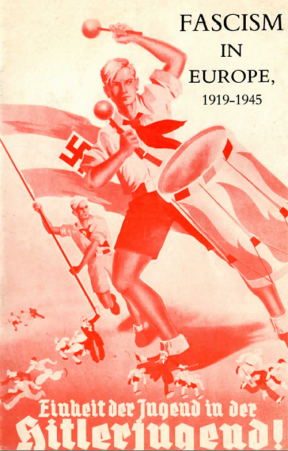
The importance of fascism in 20th Century Europe is beyond question. But what was - or is - fascism?It is synonymous with authoritarian rule or the totalitarian state, or with both? In political terms, is fascism ‘right-wing' or ‘left-wing', revolutionary or reactionary? Why did it develop? Was it truly only...

The field of Holocaust studies has been hit by an intellectual earthquake whose precise magnitude and long-term consequences cannot be ascertained at this stage. In 2007 Saul Friedländer published The Years of Extermination: Nazi Germany and the Jews 1939-1945. The book has been rightly celebrated as the first victim-centred synthetic...
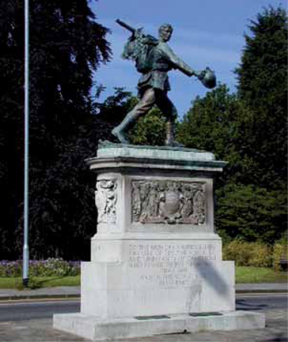
Over the past two decades the historiography of the Great War has witnessed something of a revolution. Although historical revisionism is, of course, nothing out of the ordinary, the speed with which long-held assumptions about the First World War and its impact have been swept away has been quite astonishing....
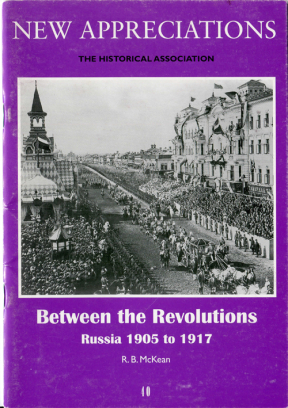
"The key question is this - is the peaceful renovation of the country possible? Or is it possible only by internal revolution?"This quotation succintly expresses the problem that faced both contemporaries and subsequant generations of historians confronting the development of Russia between the revolutions of 1905 and 1917. The upheavals...
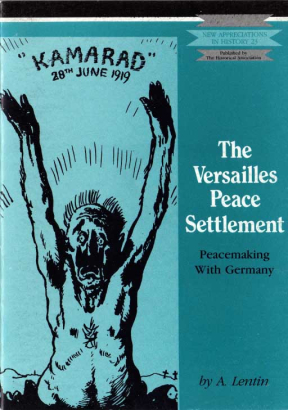
This classic pamphlet takes you through the Paris Peace Conference and the 'German Question', Peacemaking and the Treaty of Versailles, Europe and the German question after Versailles.
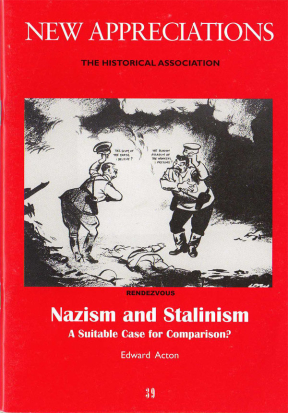
Is it legitimate to compare the Nazi and Stalinist regimes? There might seem little room for doubt. It is often taken as self-evident that the two regimes were variations of a common type. They are bracketed together in school and university courses, as well as text books, under labels such...
Berlin is a microcosm of twentieth century European history; a city that still bears many of the signs and scars of its experiences and upheavals. It is a must for any history department teaching the Modern World, taking history out of the textbooks and breathing life into it. All pupils...
Much has been written during the last 50 years about the events leading up to and during the Hungarian Uprising of 1956. Less consideration has been given to the students who arrived in Britain as refugees. During the weeks following the Soviet intervention in Hungary around 25,000 people were killed...
Diana Laffin and Maggie Wilson want their pupils to connect with people in the past and to experience some of their emotions. The emotional factor is a difficult one in history, both for pupils and professional historians. When studying Eden’s actions at Suez, for example, what we lack is a...
Please note: this article pre-dates the 2014 National Curriculum and some content may be outdated. Much has been said and written about different learning styles in recent years. Some people have responded with evangelical enthusiasm, others exercise a more cautious approach, whilst a few disregard it completely. Certainly, there are...
Polychronicon was a fourteenth-century chronicle that brought together much of the knowledge of its own age. Our Polychronicon in Teaching History is a regular feature helping school history teachers to update their subject knowledge, with special emphasis on recent historiography and changing interpretation. This edition of 'Polychronicon' investigates World War...
Polychronicon was a fourteenth-century chronicle that brought together much of the knowledge of its own age. Our Polychronicon in Teaching History is a regular feature helping school history teachers to update their subject knowledge, with special emphasis on recent historiography and changing interpretation. This edition of 'Polychronicon' focuses on historians...
Rosalind Stirzaker has big ambitions for her students. She wants them to do more than make a simple list of the key causes of the Second World War. Yes, she wants them to complete a piece of written work, but she wants – and gets – a great deal more...
In the first of our special, extra ‘Europages’, funded by the Council of Europe (CoE), Mark McLaughlin briefly outlines the purpose and outcomes of a CoE project on ‘learning and teaching about the history of Europe in the twentieth century’. His short article reminds all history teachers of the need...
Nicolas Kinloch’s 1998 review of Michael Burleigh’s Ethics and Extermination in Teaching History, 93, sparked a debate amongst our readers about the teaching of the Holocaust, concerning both rationales and practical approaches. Citing the damage caused to pupils’ understanding by a Spielberg view of history, he emphasised that the rationale...
No institution is better known for its continuing work on the Holocaust than Jerusalem’s Yad Vashem. In this article Richelle Budd Caplan offers guidelines for teachers, based on its unrivalled experience. She demands that our teaching of this subject should aim to restore the identities of the victims. To do...
Clear themes run through the work of the history department at Huntington School. A remarkably consistent emphasis on language and literacy, including work on speaking and listening of many types, is a hallmark of this sequence of six Year 9 lessons on the Holocaust, described in detail by head of...
The new Holocaust Exhibition at the Imperial War Museum in London has been very favourably received by the general public, and by teachers and their students. Initially controversial - was a war museum the ideal site for such an exhibition, for example? - it has since been widely praised for...
Challenging stereotypes and avoiding the superficial: a suggested approach to teaching the Holocaust
Alison Kitson provides a rationale for a scheme of work for Year 9 (13-14 year-olds). She argues that teachers should analyse the kind of historical learning that is taking place when the Holocaust is studied. Critical of the assumption that learning will take place as a result of exposure, she...
Ian Luff constructs a rationale for the use of drama, practical demonstration and roleplay in pupils' learning. He follows this with a wealth of practical examples and detailed advice based on his own professional experience and his experience in running training sessions for other teachers. His analysis of the value...